
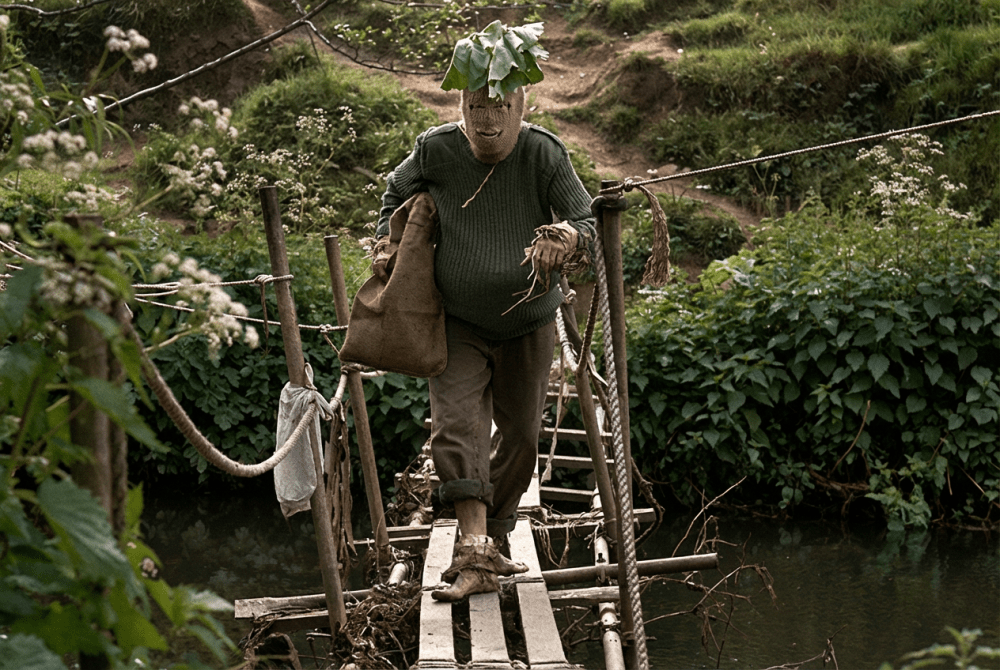
A “wood-creature” from Wild Garlic camp.
During the 1990s, a civil and bloodless war was fought on English soil. The ‘battles” – Bollin Valley, Fairmile, Twyford Down and Newbury, to name a few, were a series of environmental protests to save ancient woodlands threatened with destruction by government road building and airport construction projects.
Many named the 1996 Newbury protest the “third battle” of Newbury – the first and second battles having been fought in 1643 and 1644 during the three English Civil Wars1. The environmental protests are a different kind of civil war – the fourth English civil war if you like. It will never garner as much attention in the history books as the bloody clashes of the seventeenth Century but is perhaps of greater significance. After all, the Republicans and Monarchists fought each other merely to determine which men would rule over other men, whereas the struggle of the eco-warriors, as they were named by the press, was to preserve that upon which all mankind depends.
1. The three English Civil wars were fought between 1642-1651.
·
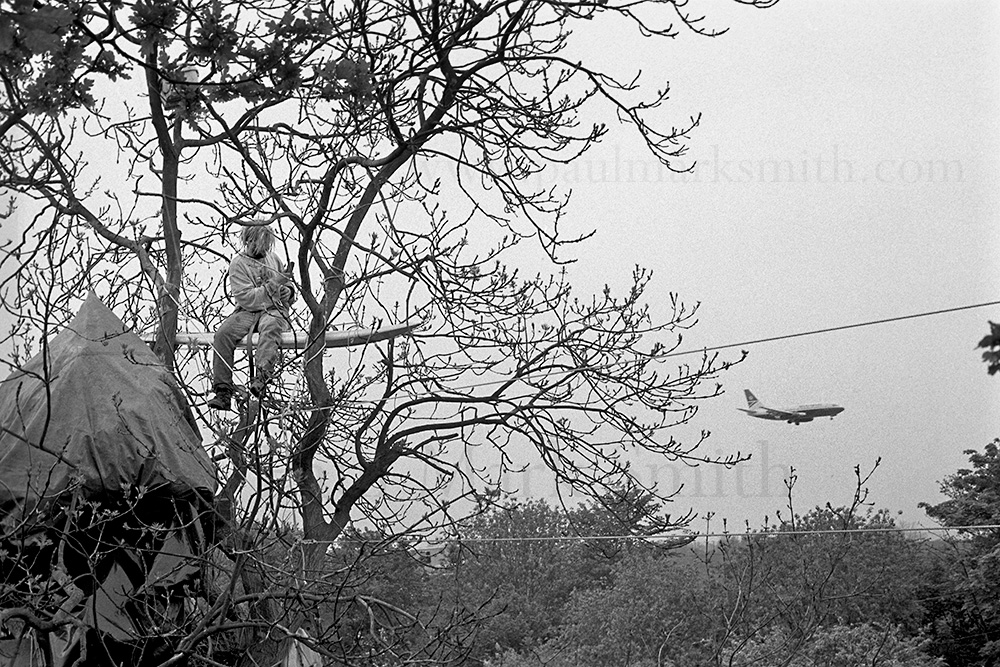
Dee Smith sits on surfboard as a plane lands at Manchester Airport
The end of the first day of our protracted eviction
The sun sinks over North-West England and a golden green haze pervades the foliage high in the canopy of Arthur’s Wood. Amongst the branches, small birds skip, chatter and twitter; squirrels scuttle and wood pigeons sit and coo. I lay upon a few planks fastened together and wedged high in the trunk of a tall ash tree. The odour of wild garlic and damp earth rises from the forest floor some twenty metres below. My soul drifts, carried on the sounds and scents of a summer’s eve. I am in paradise.
Several kilometres above me, an airliner moves slowly across the sky, slashing the vast expanse of blue with a white line of vapour. About me, hundreds of silken threads dangle from the leaves, glinting as they sway in the breeze. From each hangs a tiny caterpillar, twirling and dancing pirouettes; spinning the delicate chrysalis in which it will hide from sight its magical metamorphosis, before emerging in colourful splendour to take flight, flutter and dance the last waltzes of its ephemeral existence.
It seems unlikely that I’ll see the woods filled with the confetti of fluttering wings. Soon, all will be hacked down, stripped and removed so that the can be buried under thousands of tonnes of landfill upon which Manchester Airport’s second runway will be built.
The eviction of our encampment, Sir Cliff Richard OBE, Vegan Revolution, Sir Cliff for short, began this morning. All day long the woodland has resonated with the takka-takka of percussion drills and the squeal of chainsaws, as bailiffs and climbers drilled lock-ons, chopped down trees and plucked the activists from the trees.
Now, there is a brief respite. The bailiffs and the police have clocked-off for the day and we can enjoy the calm of nature on a warm summer’s eve. The activists, unpaid but well prepared, sit it out in the trees and down the tunnels. Four have been detained and arrested today., which is not so bad considering. Though, we will not prevent the destruction of the woods, each day costs the government and contractors tens of thousands of pounds in salaries and logistics. It is something they would have had to budget for. And therein lies the logic: this and subsequent construction projects will cost a few million pounds more, while the costs of maintaining the resistance are far greater in willpower than theya re in pounds sterling. This is an attritional war.
As the sun nears the horizon, as has been the norm the past couple of weeks, the spitting sound of motors stuttering to life breaks the woodland calm. A constant hum of diesel generators ensues that will last until dawn. The sound drowns-out the woodland symphony and distracts me from my transcendent contemplations of the wonders around me. The white wash of light from halogen lamps extinguish from the bark and leaves the last flecks of gold from the sinking sun. My brief paradise is lost.
The flood lamps appeared a couple of weeks ago when the metal perimeter fence surrounding the woods was completed. Since then, we have not been able to come and go as we pleased. It was the beginning of the countdown to the evictions.
Zion Tree and Wild Garlic camps were the first to attacked and after a few days, the tree people had been removed. Only the stubborn tunnellers remain in the dark and claustrophobic chambers they have dug and scooped beneath the earth. This morning, a week after the evictions began, it was our turn. And after us, Flywood Babylon Council Estate and River Rats encampments will follow. Eventually, we will all be removed. But always remember, it will have cost them a mint. This is an attritional war.
After the first day of clearances in Sir Cliff, there were large gaps in the canopy of the woods where once branches had swayed in the breeze. Slashed ropes dangle from the trees. The ground beneath me is littered with detritus and bright patches of sawdust that contrast with the dark earth. Half a dozen policemen loiter next to large segments of tumbled trunks while several of their colleagues play volleyball on the grass by the perimeter fence.
There are still about a eighteen of us in the trees. In the tunnels, below ground there are four more. During the course of the day, four activists have been prised from their lock-ons, removed from the trees and detained. Of the five original encampments dotted around the woodlands of the Bollin Valley, only three of us remain.
•
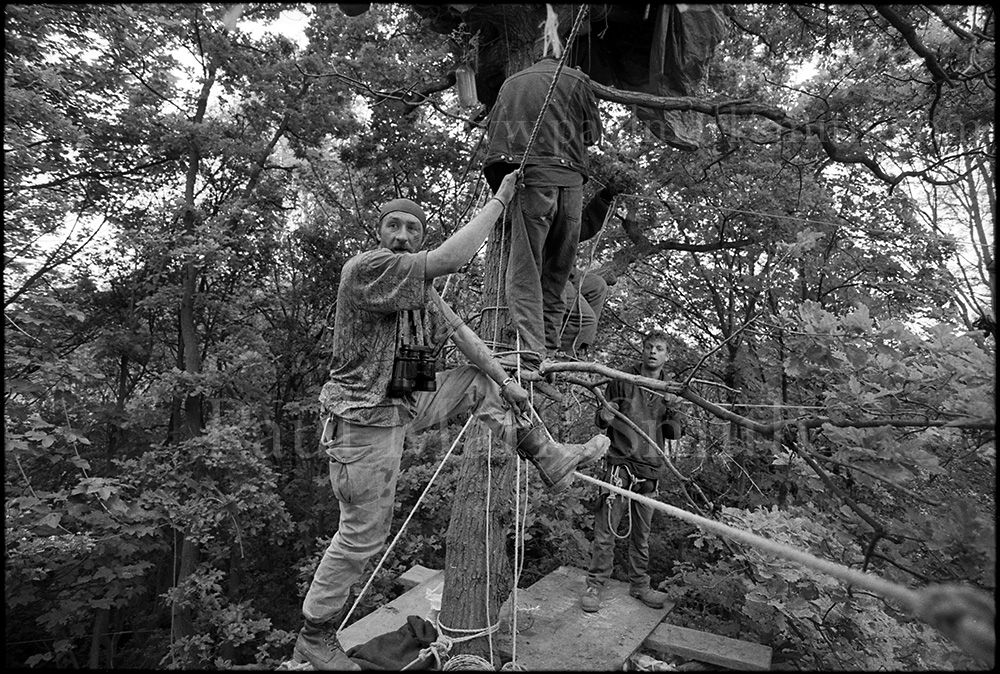
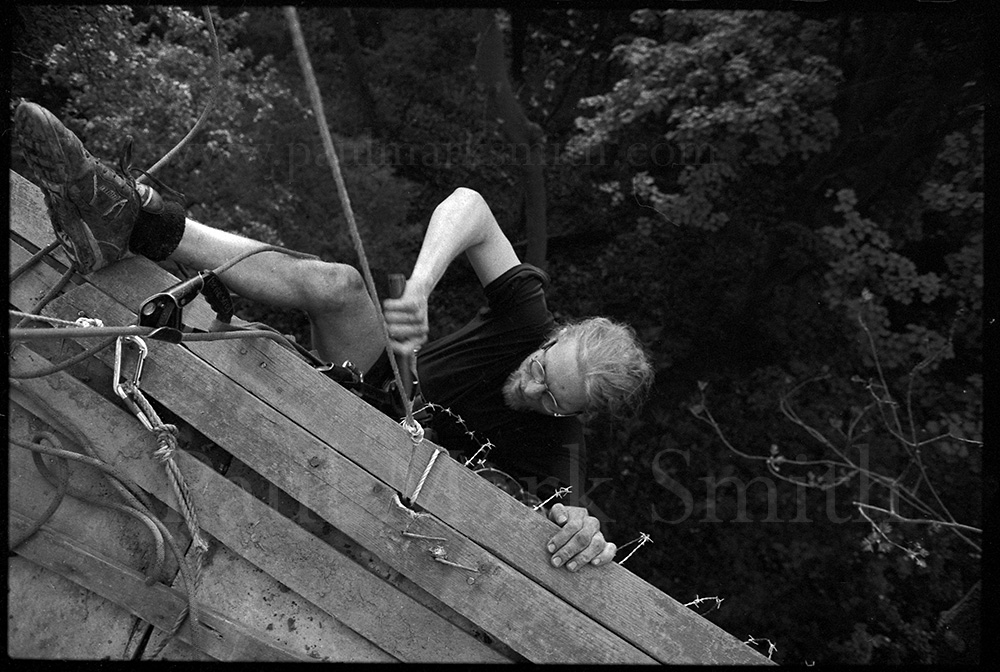
The Beginning of the End – a week earlier
As a large, orange moon slips beneath the horizon and the dawn light begins to colour the day, I awake to shouts and whistles from the trees. In my socks, I go out onto a rope walkway and looked into the distance. Bailiffs and police were advancing through the rising mist to start the eviction of Zion Tree and Jimi Hendrix camps. It is the beginning of the long awaited clearances of Hooksbank, Cedar’s and Arthur’s Woods in the Bollin River valley.
In Sir Cliff, the activists rush to their stations. But when it becomes clear that we were not under attack, I descended to the ground and the fire-pit where I find a large group of the activists. Someone listens to Tree FM, the protesters’ own treehouse based pirate radio station, on a small transistor radio. There is no news on the airwaves. All we hear is thumping Techno music coming from the transistor. Some updates do come though, via CB radio, mobile phone or are shouted and relayed through the treetops.
“Babylon’s brought down four tree-people,” a voice shouts from up in the trees. “They got a tunneller. They sprayed CS gas in his face.”
Cups of tea and an ever-dwindling supply of tobacco is passed around the fire. We listen and wait.
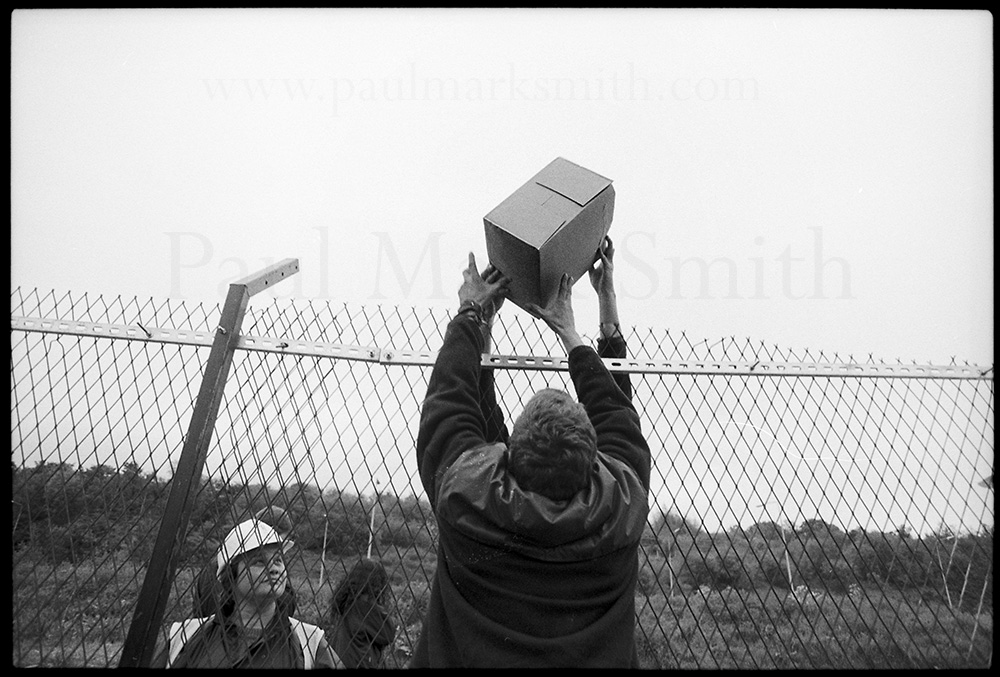
The blockade begins
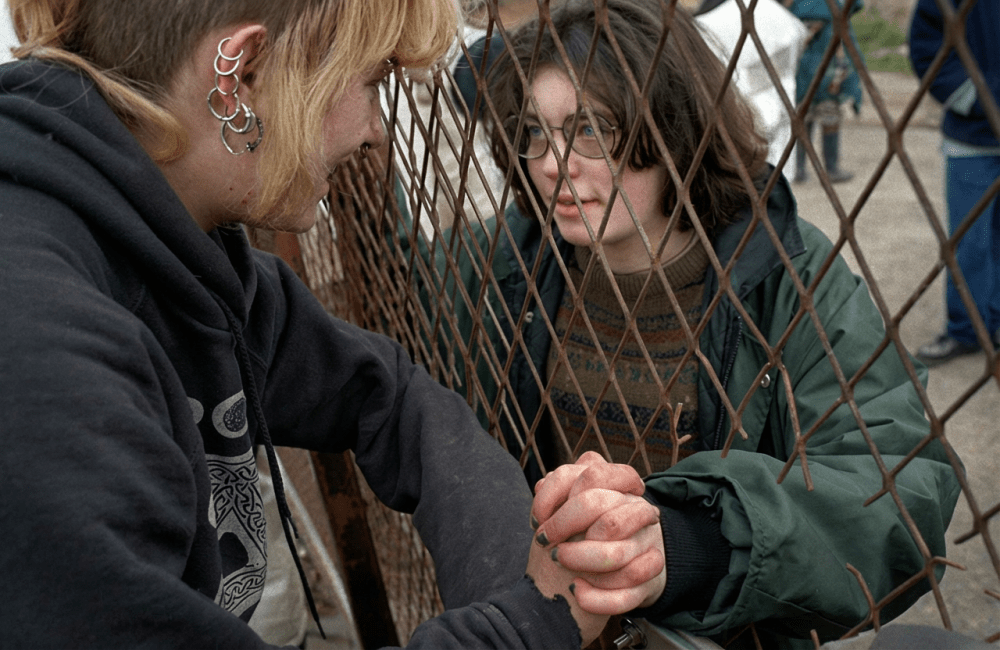
Activists talk through the fence when some are caught outside the blockade.
For weeks now, the camps have been gradually surrounded by a four-mile long, eight-foot high security fence patrolled by hundreds of guards and police. This was completed and then sealed about ten days ago and since then we have been essentially cut off from the outside world. For the first couple of days, some supplies were passed-in or thrown over the fence but those supply lines were soon cut. Over the last few days, a few activists who had found themselves on the wrong side of the fence had managed to slip past the security cordon but now no-one gets in. The only way is out.

Juggling fire before the security fence and the security guards – a distraction during which protesters beat the blockade and sneak in.
The conversation around the fire-pit is about how people think the bailiffs will enter. The general opinion is that they will just walk in. There are barricades around the camp, which will ensure we cannot be rushed. It is fair to assume that everyone will be able to reach their stations in the trees or underground, even if they rush us. The remainder of the food and water on the ground is being distributed to the tunnels and squirreled away in the trees. Large water containers are hauled upwards and hung from the walkways, by the side of lock-ons and at other strategic points.
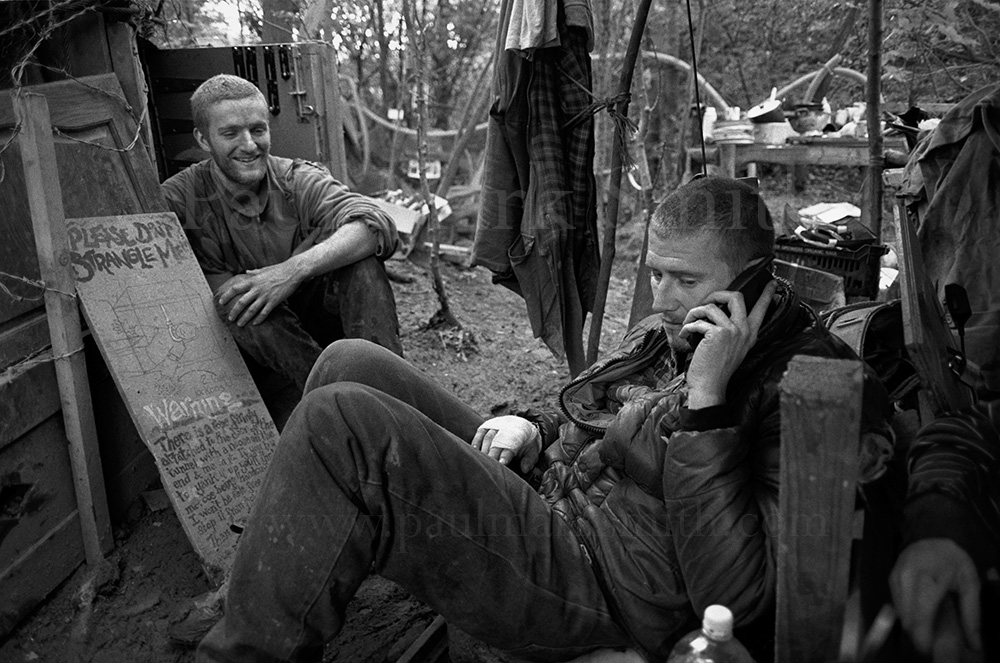
The tunnellers Wayne and Martin at the entrance to Wormhole
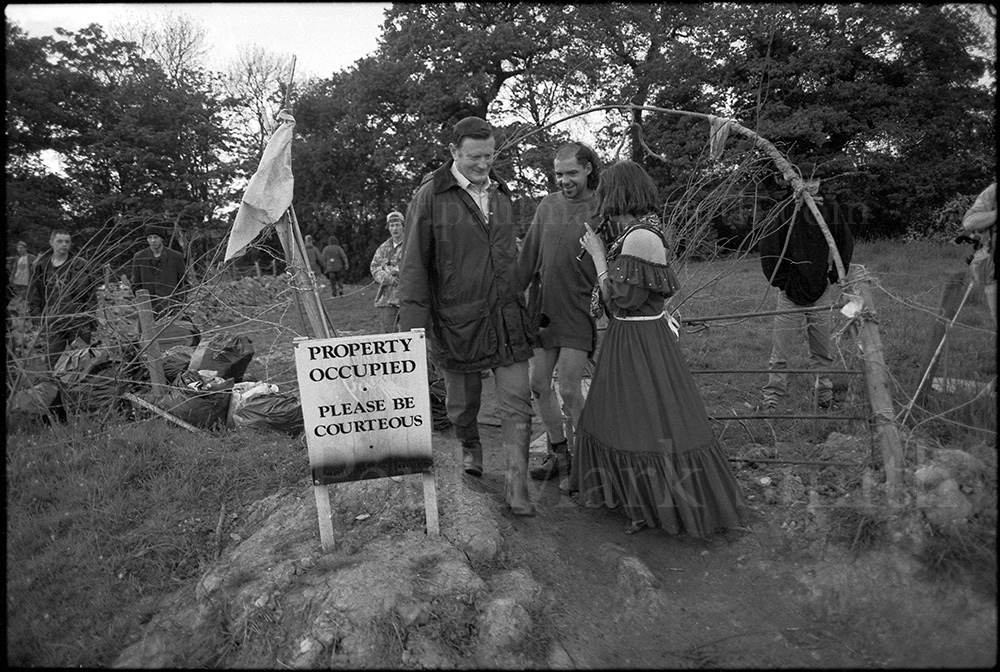
Locals from the politically conservative rural community visit the camps shortly before the blockade is total. 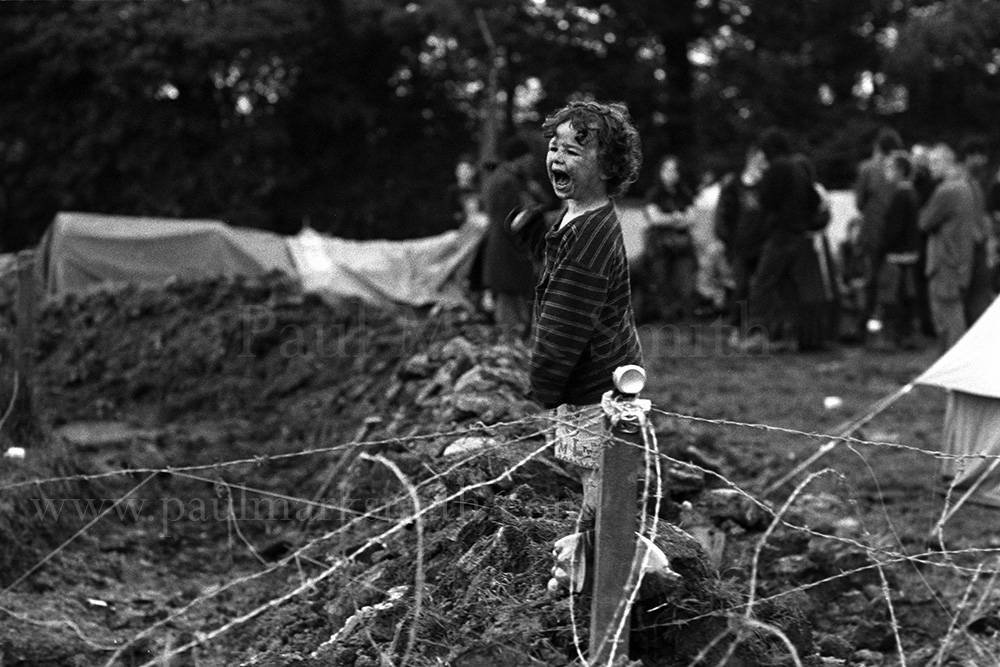
Sir Cliff’s defences are pretty comprehensive. Nonetheless, these are being strengthened. Someone is hammered barbed wire to a post while others pile more scrap wood and rigid metal netting pilfered from the evictors security fence onto our own barricades. People come and go over the dry moat, across the drawbridge and through the narrow, constrained main entrance. Our defenses are medieval, as are our appearances.
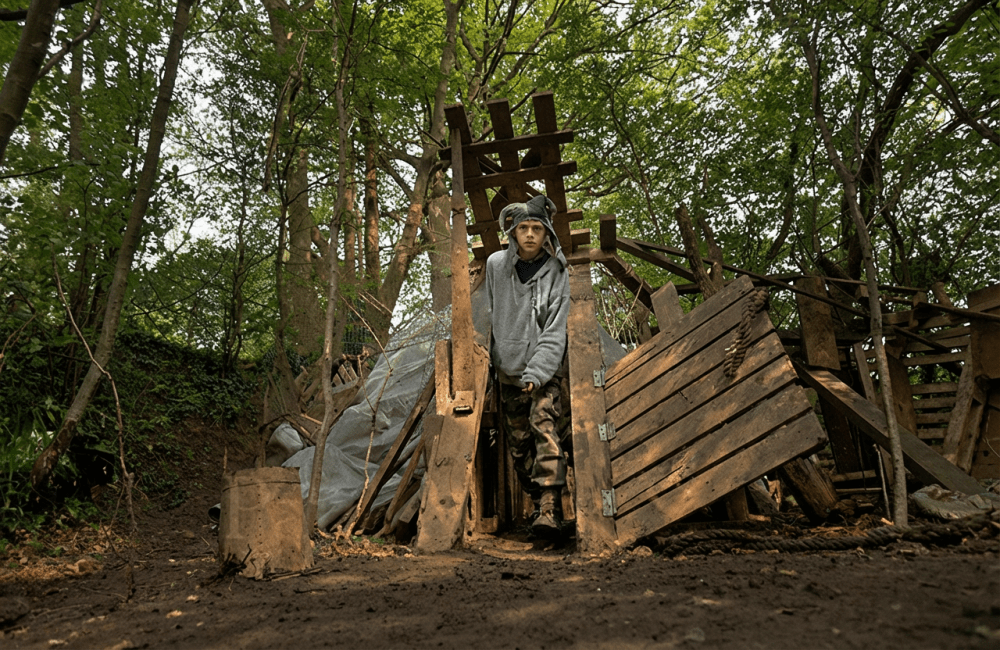
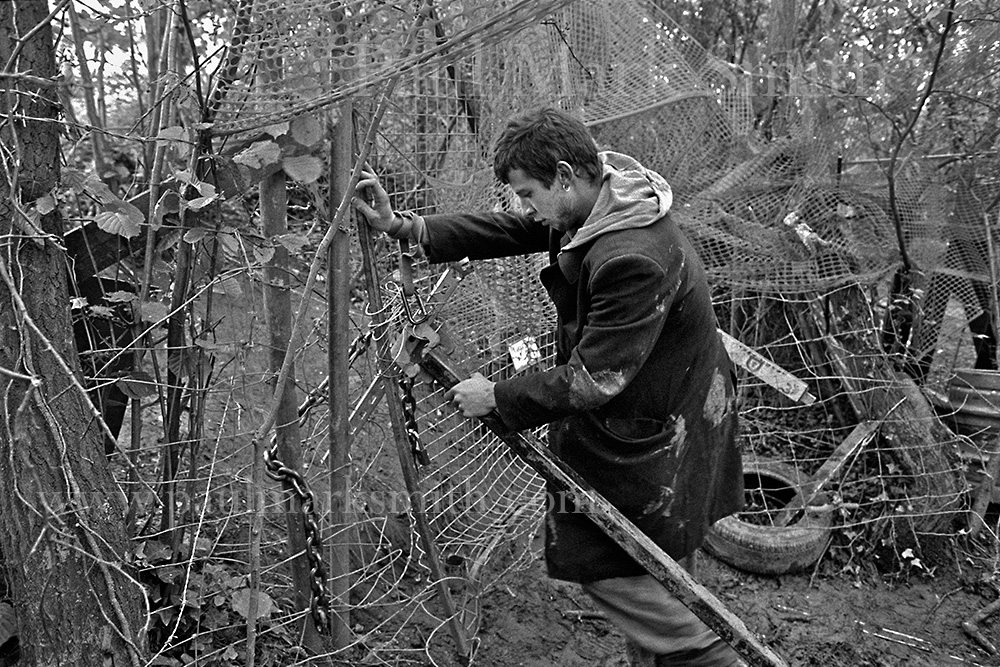
Reinforcing the camp’s perimeter fence.
From the Wormhole tunnel, the tunnellers (known as moles) are hauling up sacks of viscous mud. Heavy rains have flooded the lower chamber and they are hoping to reclaim it in time for the eviction. Wayne emerges covered from head to foot in red clay slime and carrying a sack of soggy earth. I can hear his fellow moles, Martin and Disco Dave, scooping from within the tunnel.
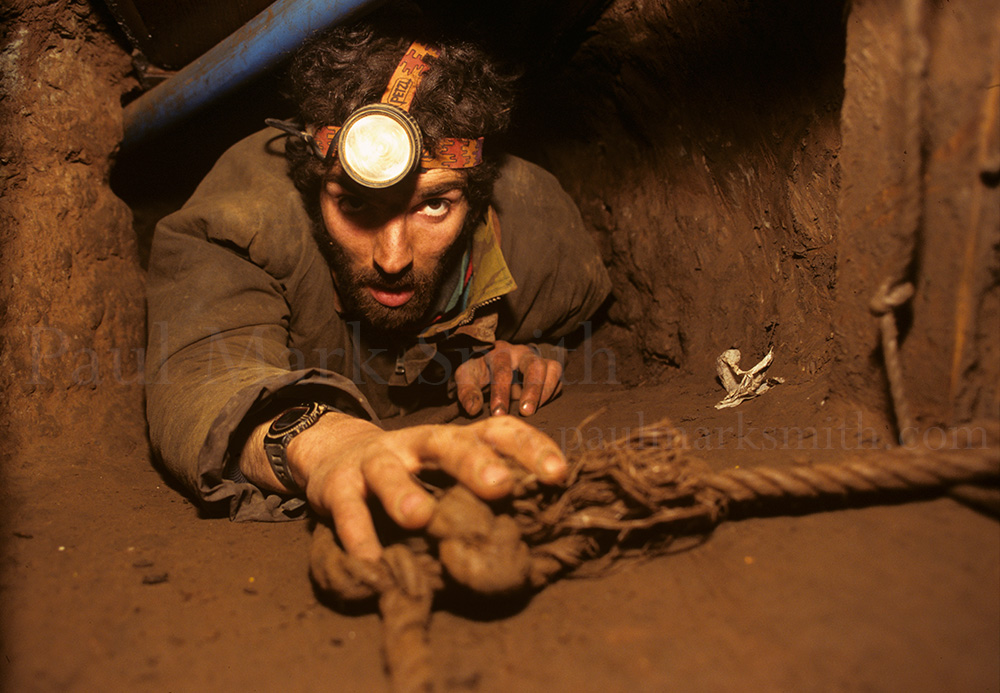
Disco Dave in the “Wormhole” tunnel. 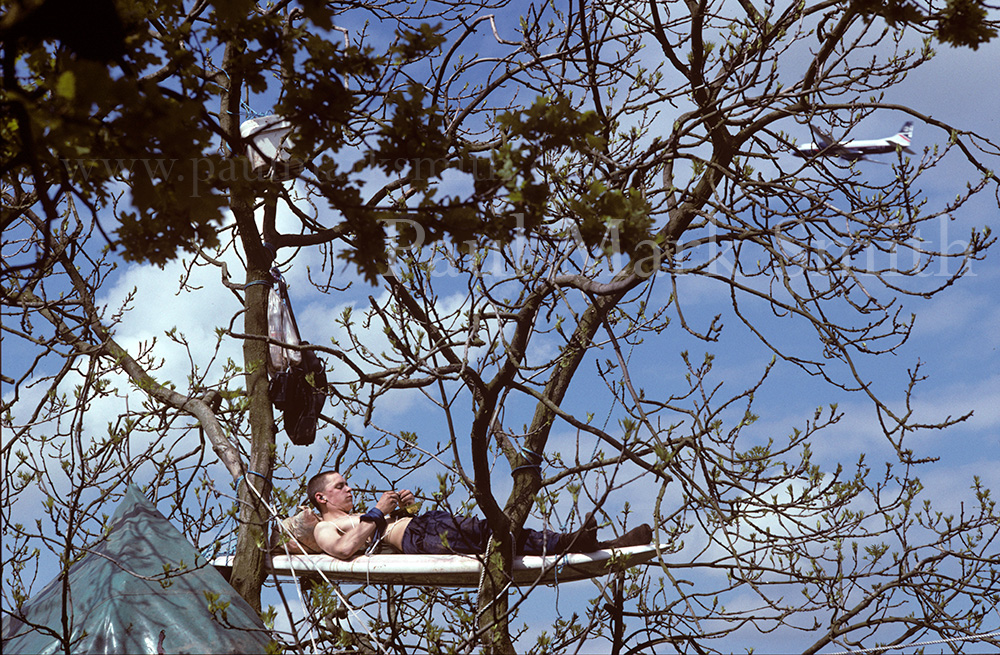
The tree people also help slop-out the gunge onto the surface close to the fire pit and then return the sacks to the tunnel to be refilled. Nearby, the fourth mole, Liz, a former art student at St. Martin’s College in London, paints an apocalyptic mural of jumbo jets and earth diggers. As we speak, a Boeing 737 aeroplane roars over our heads after taking-off from Manchester Airport. We can see it through the leaves overhead. It is close enough to see the airline’s name ‘on its fuselage – Air UK’ – and next to that, a word in large, red cursive script. ‘Leisure’ I read out aloud. Liz smiles wryly.
She tells me that her interest in the eco-protests was sparked by an article in the Independent on Sunday magazine the previous year, during the time of the Newbury bypass protests of 1996. ‘It was my mum who suggested I participate. She knew I was interested and said: ‘Why don’t you go?’ I’d seen the Newbury protests on TV and thought it was brilliant… Eventually I went.’ The Manchester Airport protest is Liz’s second campaign. It is the first time she has been a tunneller.
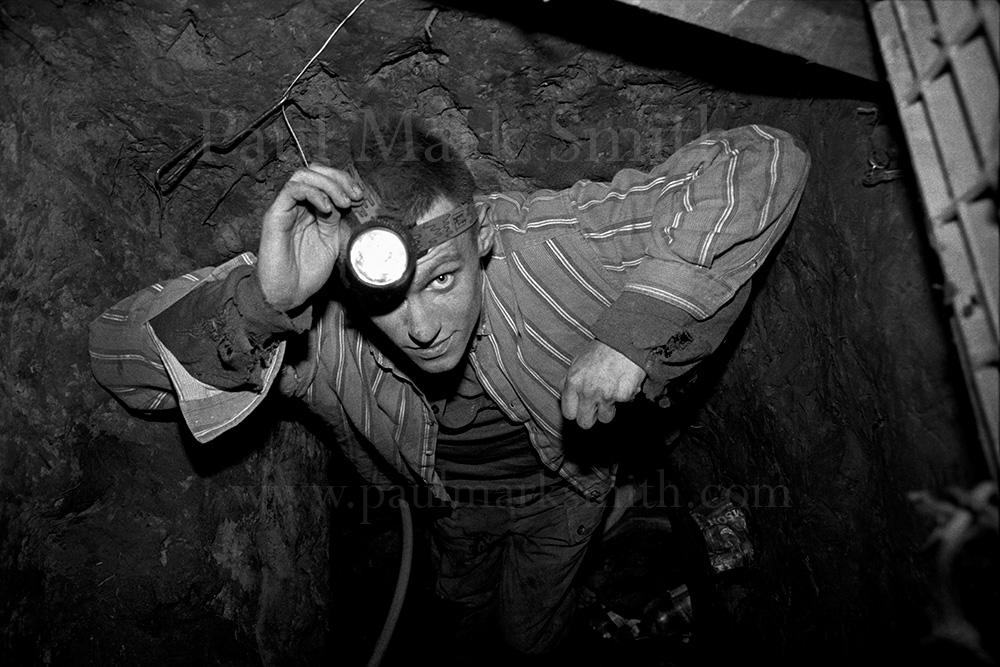
A tunneller in Flywood camp.
The moles are very careful as to who can enter their tunnels. Any information that leaks out can help the authorities to accelerate the eviction. It is unthinkable that spies have not been sent into the encampments over the past few months. They are quite literally the secret weapon of the activists. Maintaining that secrecy will ensure the evictors have to dig and cut slowly and meticulously to avoid any surprises or causing any disasters.
After I had been ten days in the camp, Disco Dave allowed me to enter Wormhole tunnel, but only after consulting his fellow tunnellers. He told me that he previously worked as ground-staff at Schipol Airport in the Netherlands before gong underground. I could go beyond Liz’s station, he told me, and into the main, long tunnel but not as far as the first chamber. There were to be no photos of lock-ons nor bolts on the rear of the inner doors.
As I crawled along the main tunnel on my belly it became apparent to me just how precarious everything was beneath earth. A couple of years earlier, when I had lived a brief period in the Dordogne where I had enjoyed free caving with a torch held between my teeth. I had voluntarily got myself into some quite tight spots there, but that had been in limestone. Mud tunnels are quite a bit more terrifying. The air was stale and saturated with the smell of mud and moisture. Everything felt clammy and stuck to you. On top of my camera was a big fashgun and a bounce card that took up half the height of the main tunnel. We stayed long enough for me to take a few transparency photos of Disco Dave and then headed for the exit. I was kind of pleased that they’d only allowed me to go in so far.
Wormhole, I was told, is fifty feet long and thirty feet deep. Thick defensive doors defend the warren, which will be held shut by several deadlock bolts on the inside of the six-inch thick main door. The tunnel is as wide as the broadest set of shoulders of the four tunnellers and leads to two chambers, in which you can barely lie and can hardly sit upright.
The moles habitually sleep in Wormhole at night to prepare themselves psychologically and practically to living underground. When the eviction cavers (who it is rumored these are from the SAS – the Special Air Service) move on the Sir Cliff, the moles will stay as long as it takes to prise them out ; or as long as they can bear it. Imagine it! Eating, drinking and having to defecate and urinate all whilst enclosed in the same space, where the best you can do is sit almost upright. Not to mention the darkness; the loss of the sense of day and night; the boredom; the cramp; the sensory deprivation.
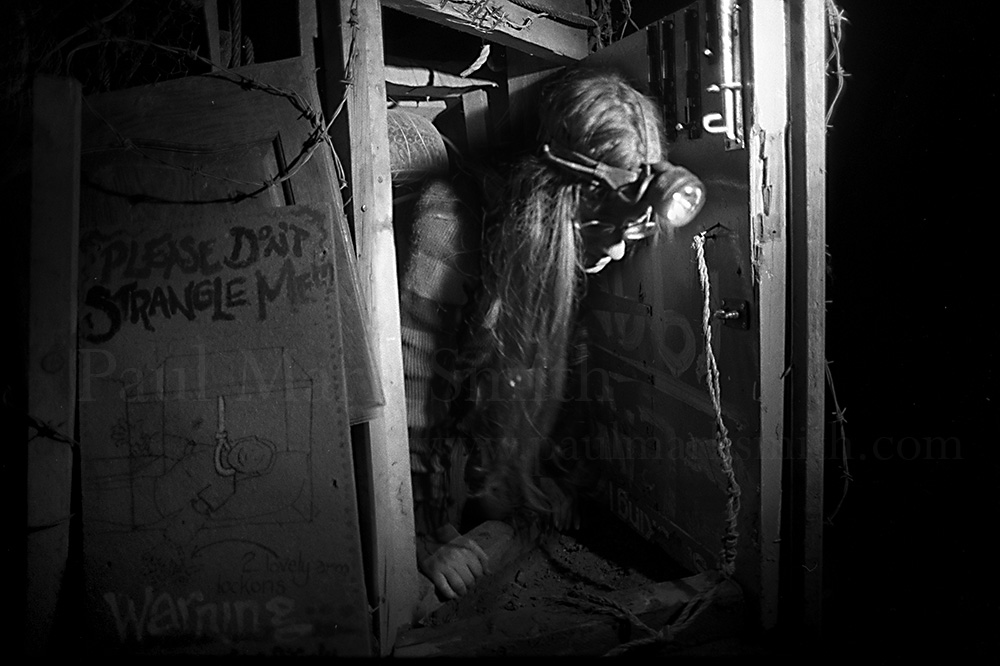
Liz emerges from “wormhole” tunnel next to her lock-on warning.
Liz’s eviction plans are somewhat eccentric and quite admirable, I thought. On a wooden board, by the entrance to Wormhole, she has drawn a diagram to inform the bailiffs a little about the set-up inside. It depicts a cartoon Liz, supine and chained by the arms into two lock-ons and with her neck in a noose, which is attached to a tunnel door. “The idea of the noose is so they can’t open the door without strangling me,” Liz explains. “There’s a warning, and that’s pretty clear, so there’s no chance they’ll do anything stupid. When you’re in a tunnel with two lock-ons, you can’t move. It’s like a crucifixion!” she says with a big smile.
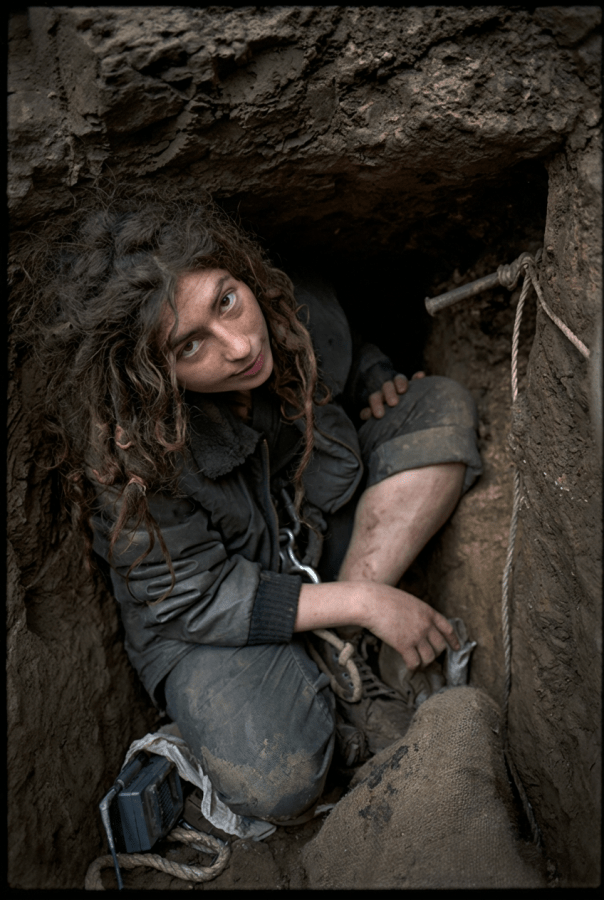
Nadine the solitary tunneller in cliff tunnel.
There is a second tunnel in the encampment, which is half way down a 40 foot-high cliff on the edge of the camp. The cliff was the inspiration for the encampment name – Sir Cliff Richard OBE Vegan Revolution. The cliff tunnel is inhabited by the calm and taciturn Nadine, who seems abit of a loner. Each night, she abseils down to the tunnel entrance and hauls herself back up in the morning. When the eviction begins, she will be the most isolated of us all: locked-on and alone in her tunnel.
Lock-ons are dotted around the camp in tunnels and fixed in concrete-filled metal barrels. They consist of tubes set in the concrete into which you insert your arm and lock-on, either with a carabiner, a lenght of harness, rope or a chain. Sometimes the activists just hold on to the meta bar fixed at the base of the tube, as there is no way of knowing just how they are fixed in place. They are the standard delaying weapon in the camps and it often takes several hours of careful chipping-away with percussion drills to remove the arm and then the protester. Double lock-ons are twice the fun.
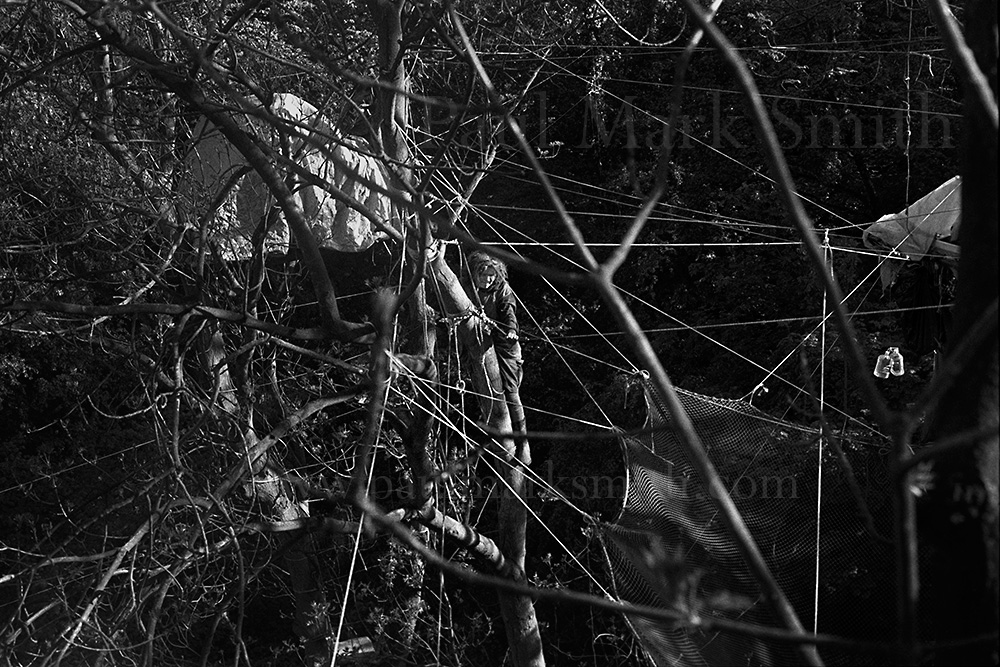
Mia on the walkways. 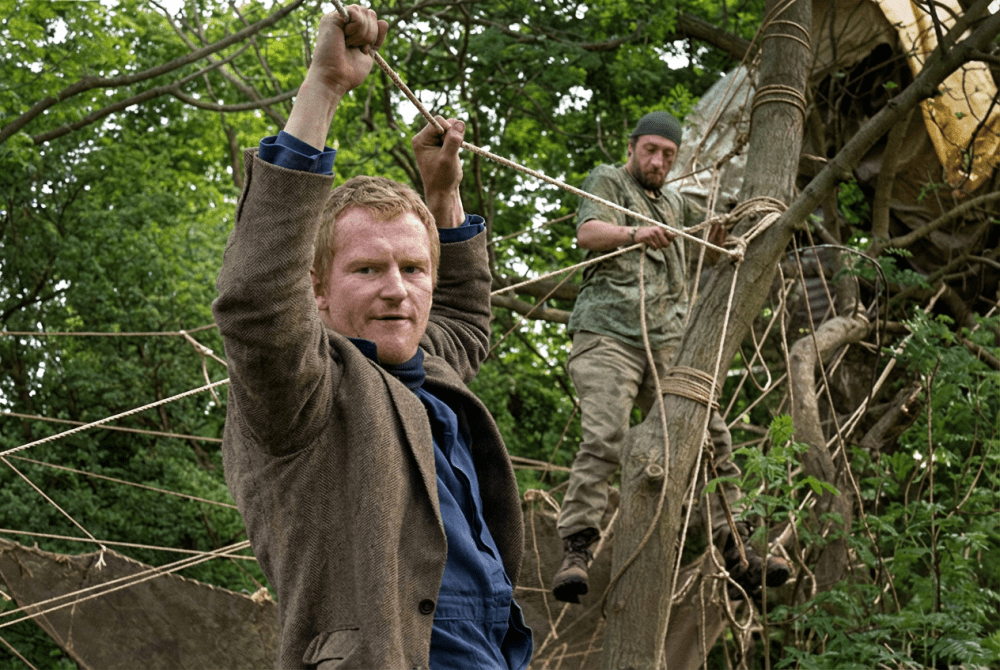
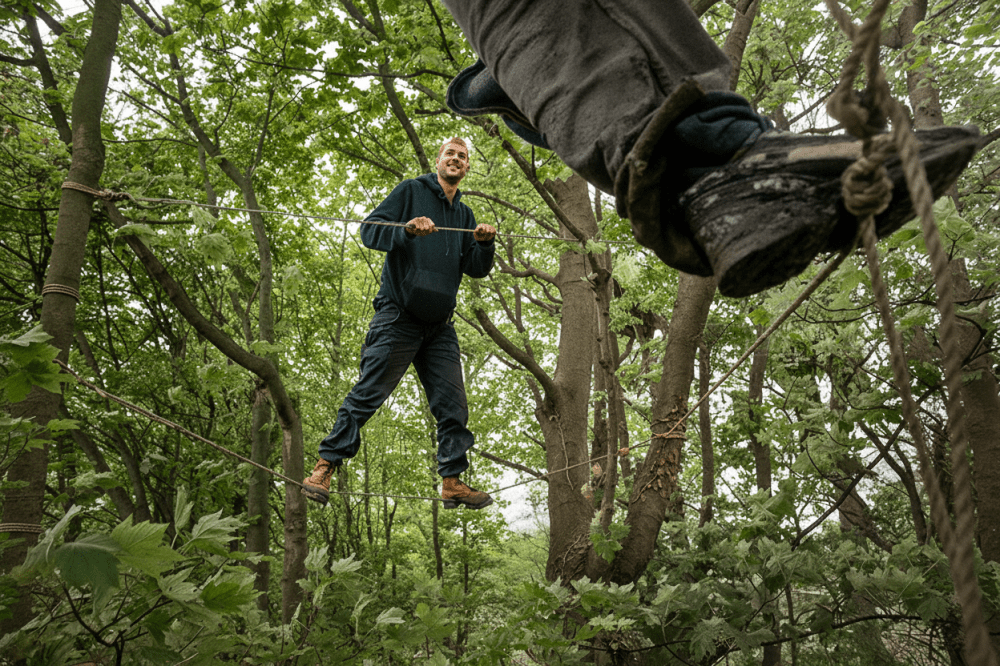
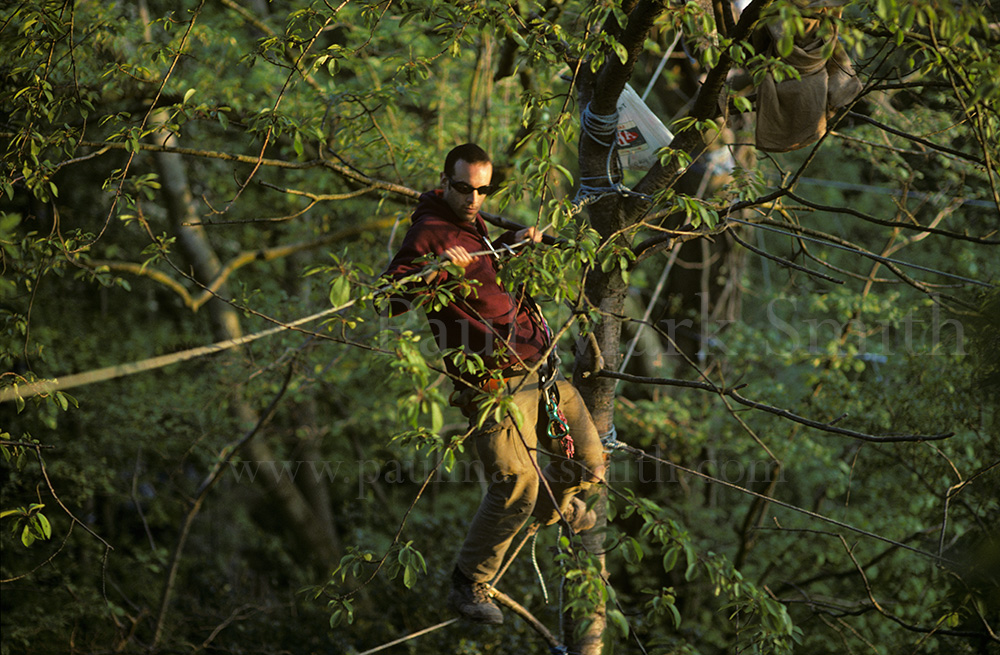
In the trees, ten tree-houses (benders) are linked by a network of walk-ways. Each of the benders is a construction of several branches, bent into an igloo-shaped frame, over which a tarpaulin is draped and tied. The walk-ways consist of two ropes, one above the other. The upper rope is for your hands and the lower for your feet. Most tree people have safety harnesses and clip-on the top rope using a carabiner. The regular click-click of the metal gate snapping shut is a common sound up in the trees.
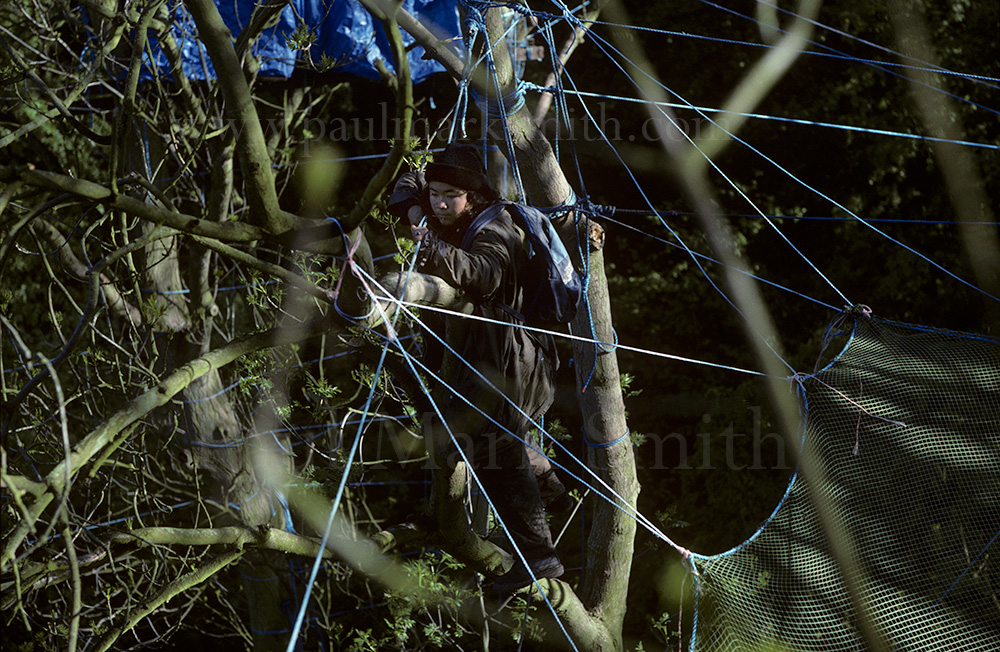
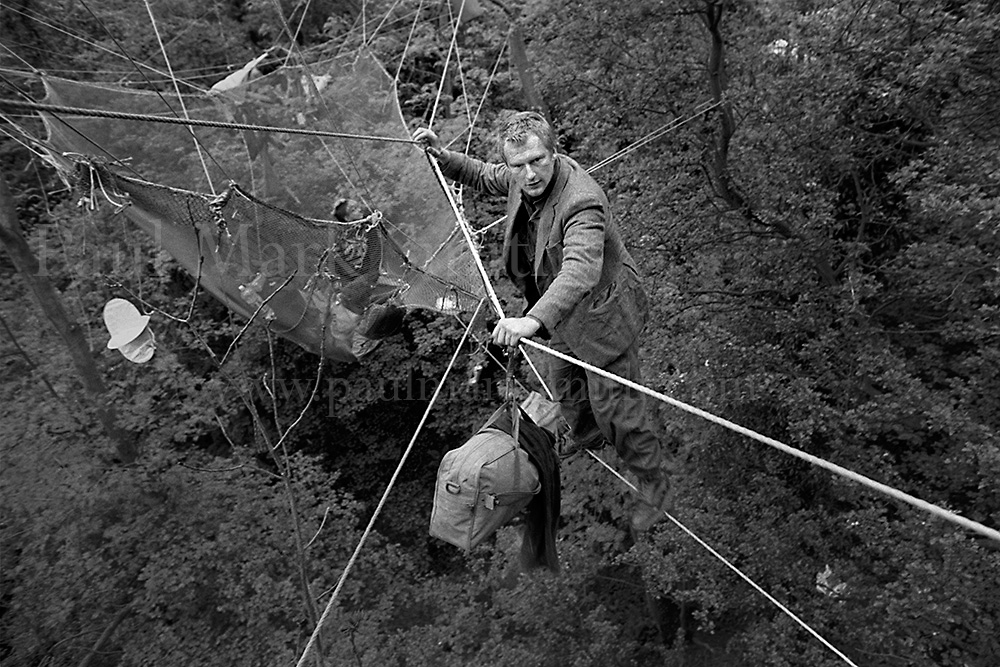
Moving supplies into the trees as Cliff Camp prepares for the eviction.
As it hadn’t occurred to me beforehand that I might need safety equipment, I made do without. A safety harness only is of use if you fall off the ropes, so I did my best not to fall. It was quite tricky taking pictures from the walkways. To have at least one hand free to hold the camera, I would hold on either by passing an arms over the top rope, nestling it in my armpits, or by gripping it between my teeth.
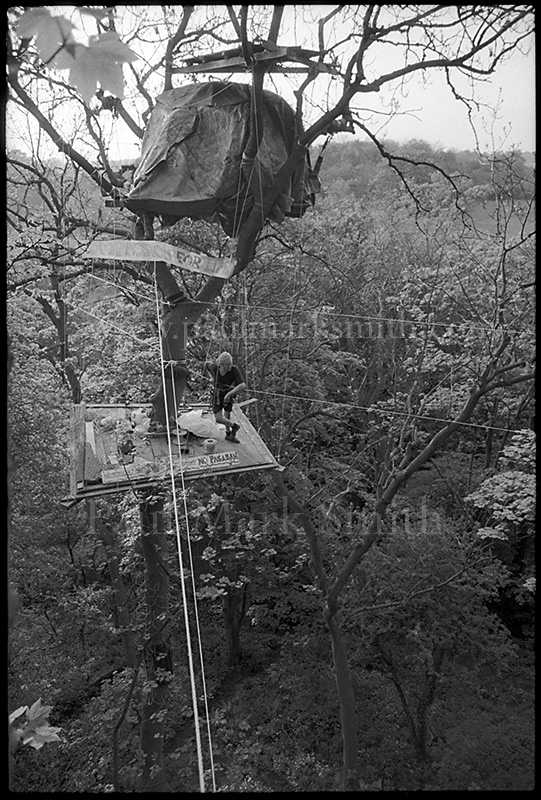
The pièce-de-résistance of the tree people is the suspender-bender – a wooden platform suspended fifty-feet in the air, fixed by a dozen ropes lashed tightly to six encircling trees. Dee Smith is the architect of the suspender-bender, which he shares with his partner, Fern, a former nurse who is tells me that she is terrified of heights. She always clips-on to when on the walkways and also quite often when in the bender.
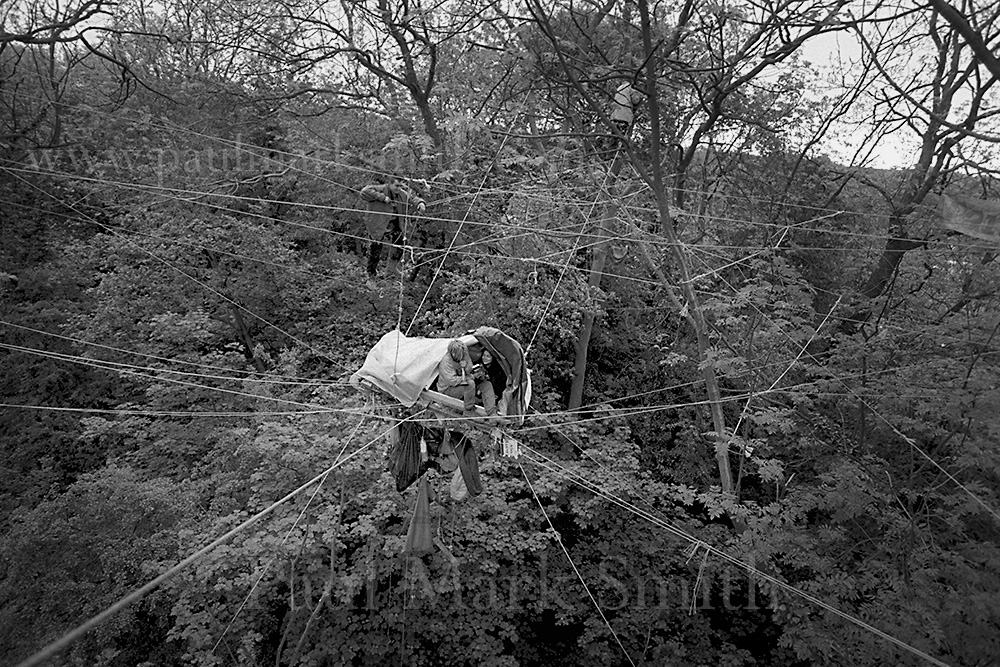
The “suspender-bender”.
The intricate network of ropes, platforms and benders, nets and lock-ons is phenomenal. It took several weeks to construct, as did he tunnels, which seem to be under continual maintenance. A lot of know-how and a lot of effort that has gone into constructing the camps. However, what has taken months to construct will eventually be torn down in a matter of moments.
The food for the encampments is donated by sympathizers. Much of it comes from nearby Manchester and from the local community, a conservative rural community and the Conservative voting town of Winslow. The cause of preserving the ancient woodlands and the Bollin Valley crosses political and social divides, as they have done so at other environmental actions in the UK. This plurality of support and the eccentricity of the protests has garnered them more attention and some degree of sympathy in the mainstream press more accustomed to condemn dissent.
One activist, Daniel Hooper, rose to national celebrity, under the sobriquet Swampy, at the Fairmile protest in Devon in 1996 when he remained underground for a week. The travails of the tunnellers are made-for-media drama, with daily or hourly running updates with all the necessary suspense to keep people watching and asking how events are developing. However, a nightly news drama is neither welcomed nor convenient for the government and constructors and, thus, the Manchester Airport pevictions are being kept behind closed door, or iron fences to be more exact.
Like any self-respecting resistance force, the Bollin Valley activists pilfer many of their resources from the enemy. The principal of these is the metal fencing and wire, which is used to strengthen the camps’ boundaries and some other structures. Other “spoils of war” are of more symbolic and moral boosting value, such as the helmets of policemen or bailiffs – one of which adorns the walkway over the bender I share with Mia and James. A feature of the protest is having fun, which breaks up the monotony of waiting on the front-line. Acts of mischief are called a pixie.
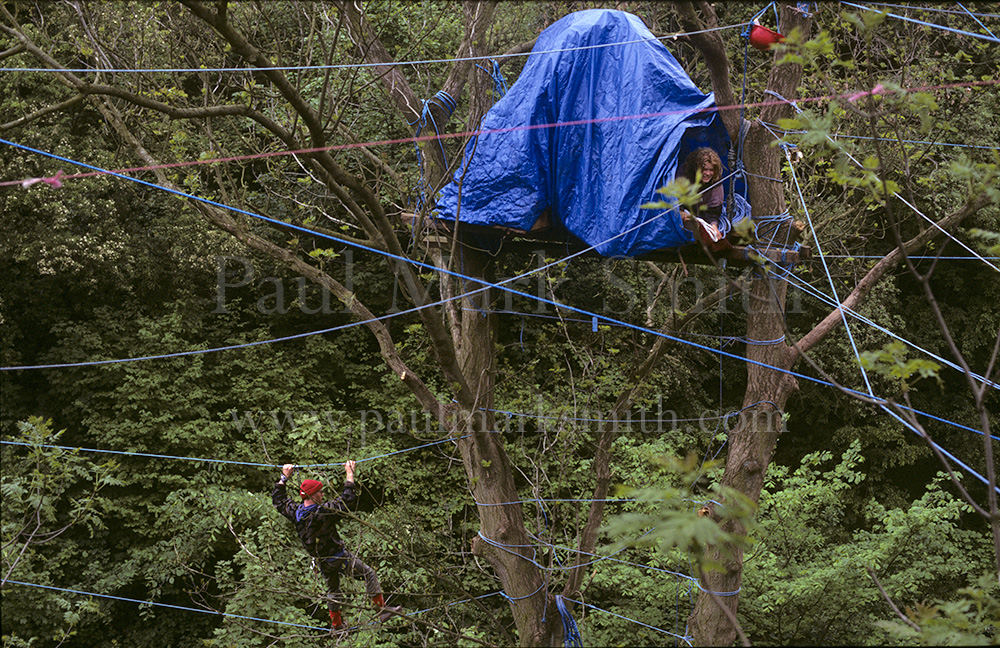
Mia in the bender in an ash tree. The red helmet is a trophy pilfered from a senior security person during a “pixie”.
Often the pixies are nighttime raids to turn off generators or hack holes in the metal fencing. Tales of pixies are shared around the firepit. These can be as simple as sneaking in over the fence and past security guards after the completion of the encirclement or, more daringly, someone breaching the under-eviction Wild Garlic camp siege to deliver a flask of hot tea to the tree people. Also, it was not unheard of for the climbers and bailiffs to have equipment swiped when their backs were turned for a few seconds.
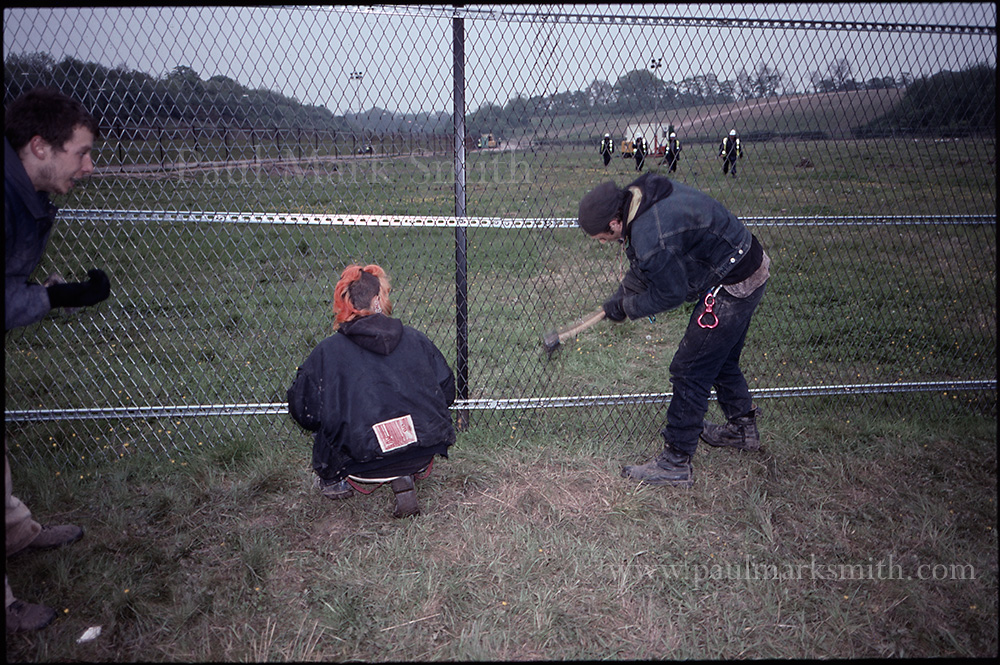
An early evening “pixie” shortly before the evictions begin.
The most common pixie is to go and get in the way of the fence building by gathering and chaining together for a sit down. It is during these that many of the security guards’ and bailiffs’ helmets are spirited away. There is an emphasis to keep these encounters good natured – what the activists term fluffy – but sometimes offended egos can spark testosterone induced grunting and scuffles.
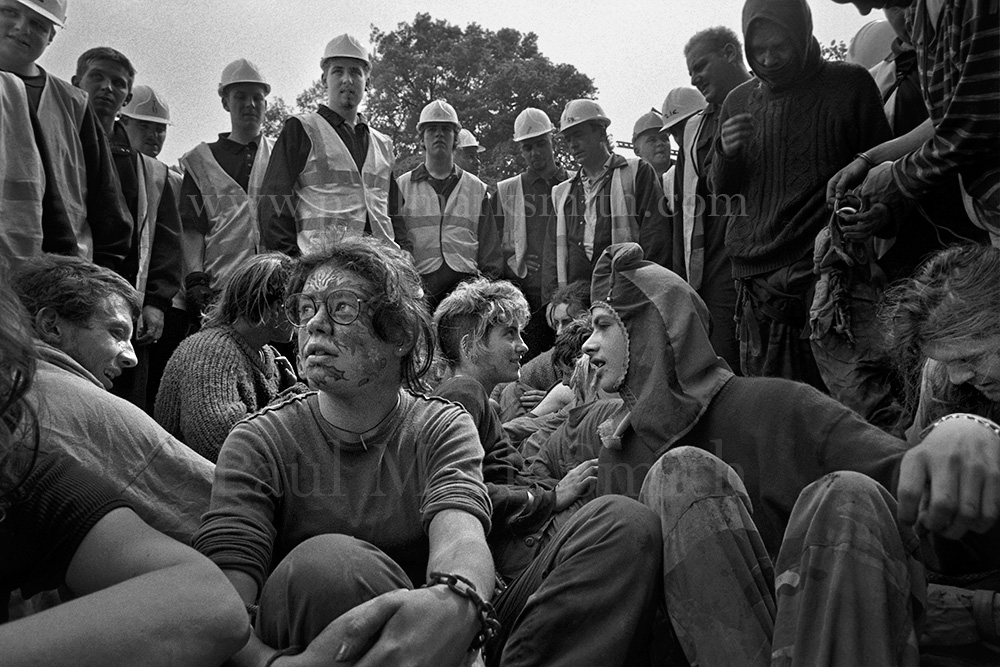
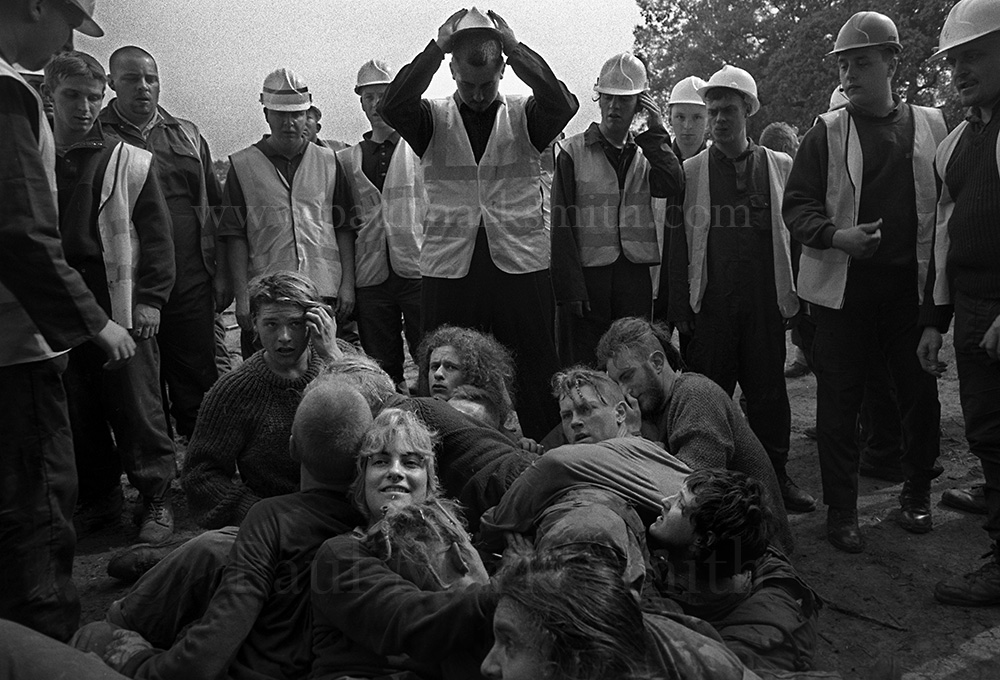
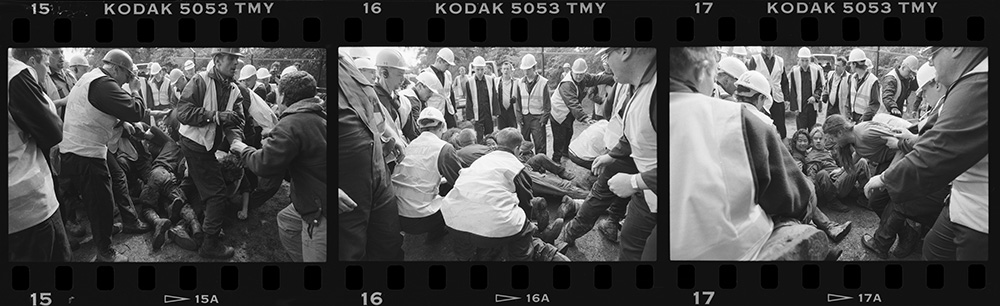
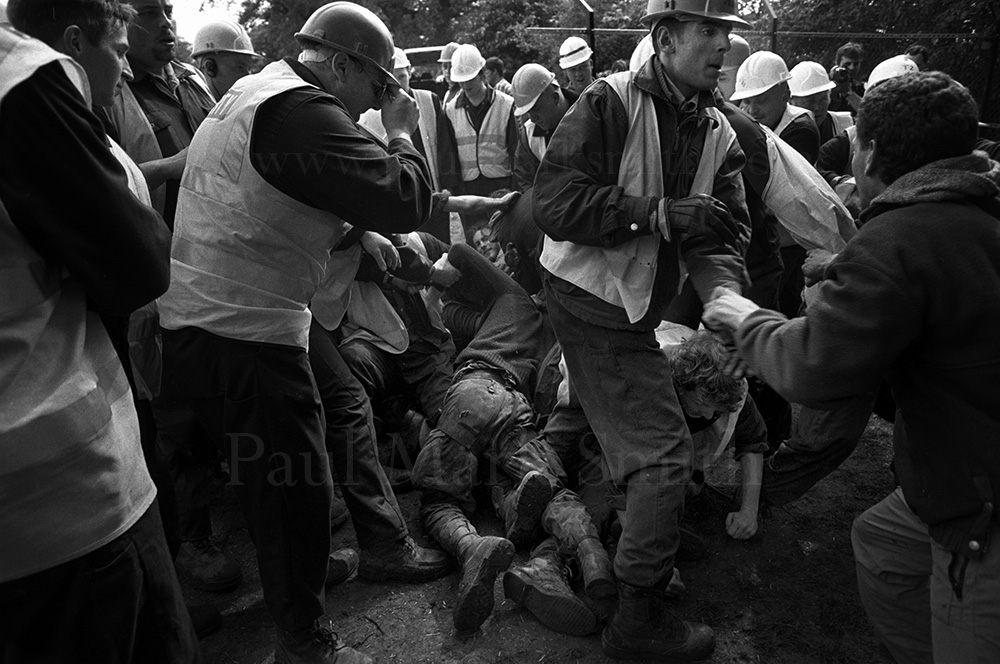
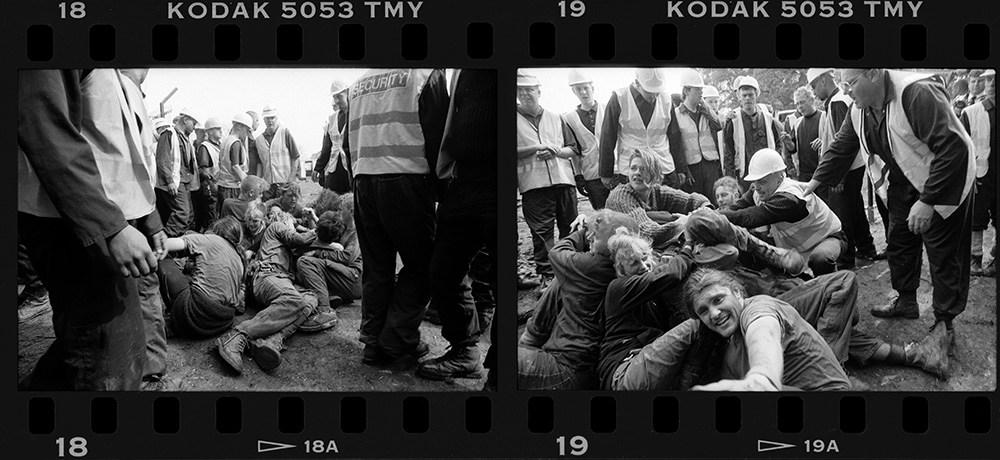
Babylon comes to Cliff
By end of the second day of the evictions, much of Zion Tree has been evicted and the eviction is concentrated on Wild Garlic camp. Wild Garlic is our closest neighbour. It is down the hill, over a small wooden bridge over a small brook and then a three minute stroll through the woods. Sat around the firepit, we discuss the final arrangements for the impending attack on Sir Cliff. The intermittent sound of chainsaws and drills from Wild Garlic reminds us of our own impending fate. As we share what could be our last hot meal, a pulsing whir of a chainsaw sounds from close to the brook, followed by the crackling of timber fibres snapping and then a dull thud. “Earth Rapists ! Scum!” shouts Hugie whilst chewing a mouth-full of veggie burger, spitting bits all over the fire.
The next day, the chainsaws fall silent and we presume our turn will come the next morning. As it happens, the attack does not come for a few days. A week since the beginning of the evictions, the bailiffs finally come walking into Sir Cliff at eight in the morning, during normal working hours. Cries of ‘Aruga’ are shouted from the trees and echo around the woods.
Everyone has time to get to their stations as the bailiffs gather their men and machinery on the edge of the woods. I am on the ground and accompany Nadine to see her abseil one last time to the cliff tunnel. When we get there, we see that a group of climbers has snuck up the back way and is readying to scale the cliff. They are hindered by a world-war-onesque tangle of pilfered barbed wire and steel supports, which gives Nadine time to casually abseil down and lock-on.
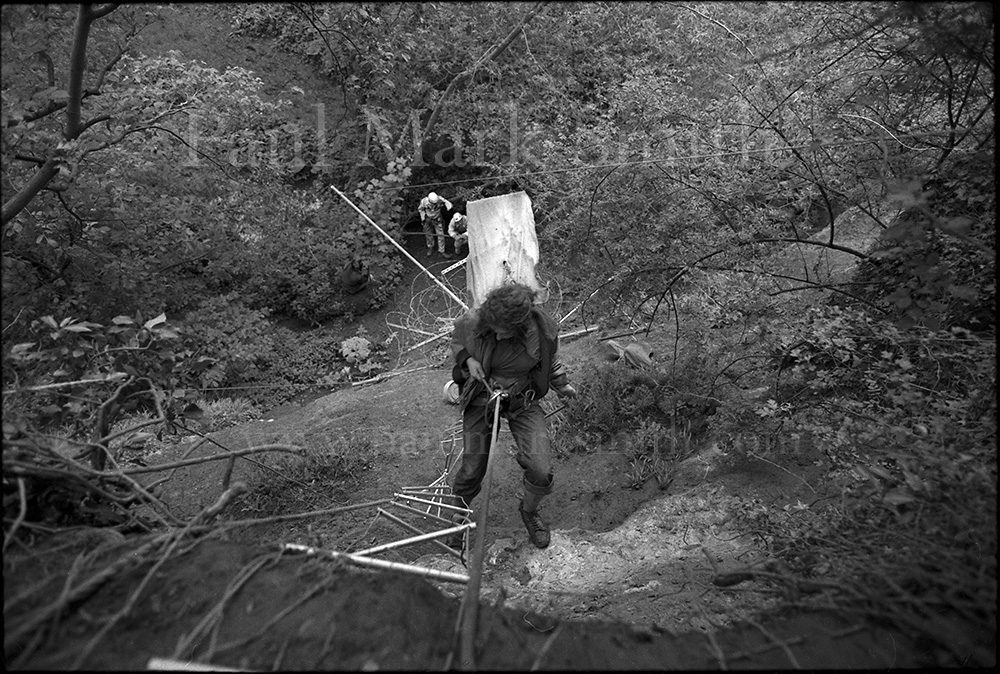
Nadine abseils down to her cliff tunnel, as climbers prepare to scale the cliff.
With Nadine safely in her tunnel, I run back to the firepit, scale a tree and climb onto the walkways to make for the bender. As I move along the walkways, cheers of ‘Come on in!’ rain down from the trees above. I look down and see the climbers breaching the perimeter somewhat awkwardly. Behind them, the bailiffs follow, laying metal sheet bridges over the moat and barricades.
When I reach the bender, a loud hailer squeals and a grunts and then announces: “I am Randall Hibbert …Cheshire…Sheriff…”
“Bollocks!” comes the reply from the trees, followed by jeers and cheers. The remainder of the verbal eviction notice is drowned out by the noise. On the ground, the camp begins to fill with men in uniforms, overalls, hard-hats and helmets. They go about dismembering the camp. Puddles of water are filled with rocks and metal gangplanks are dropped over holes and other obstacles. When I reach the bender, I sit with Mia from Finland and James from Australia to watch the spectacle below.
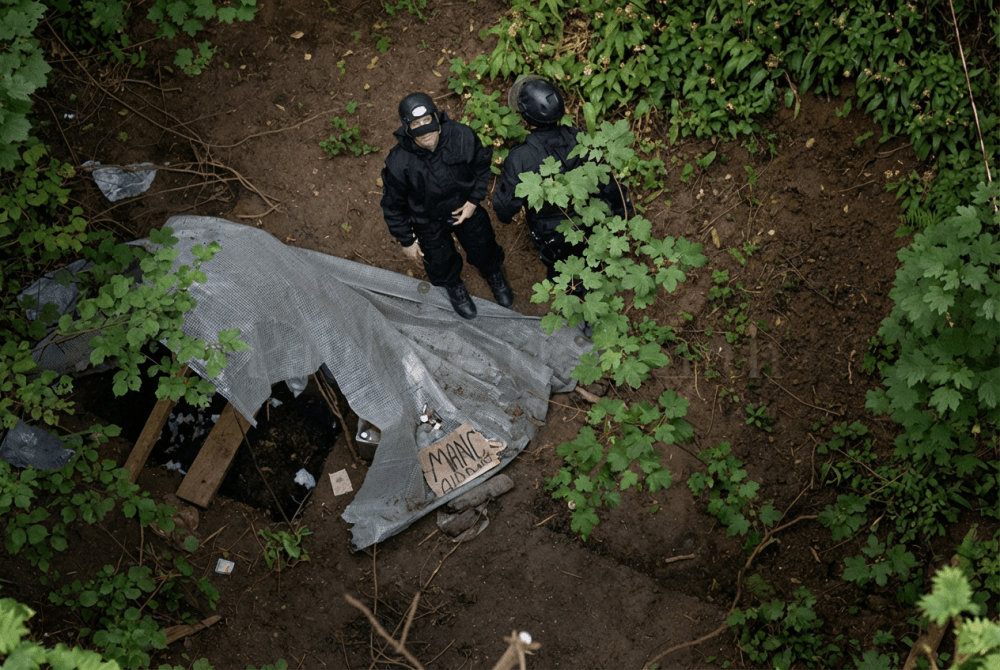
Special forces arrive to inspect the tunnels for eviction 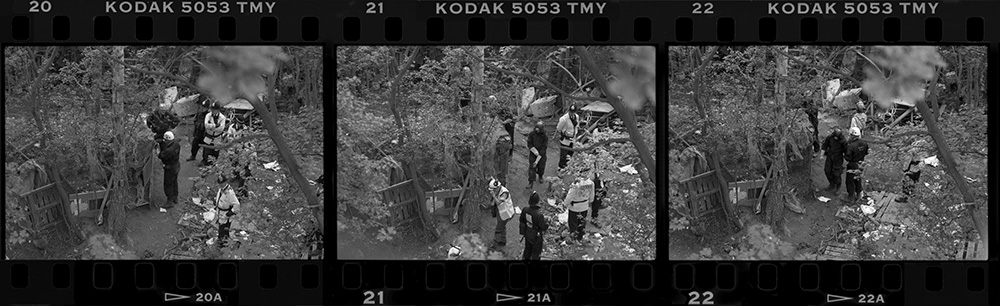
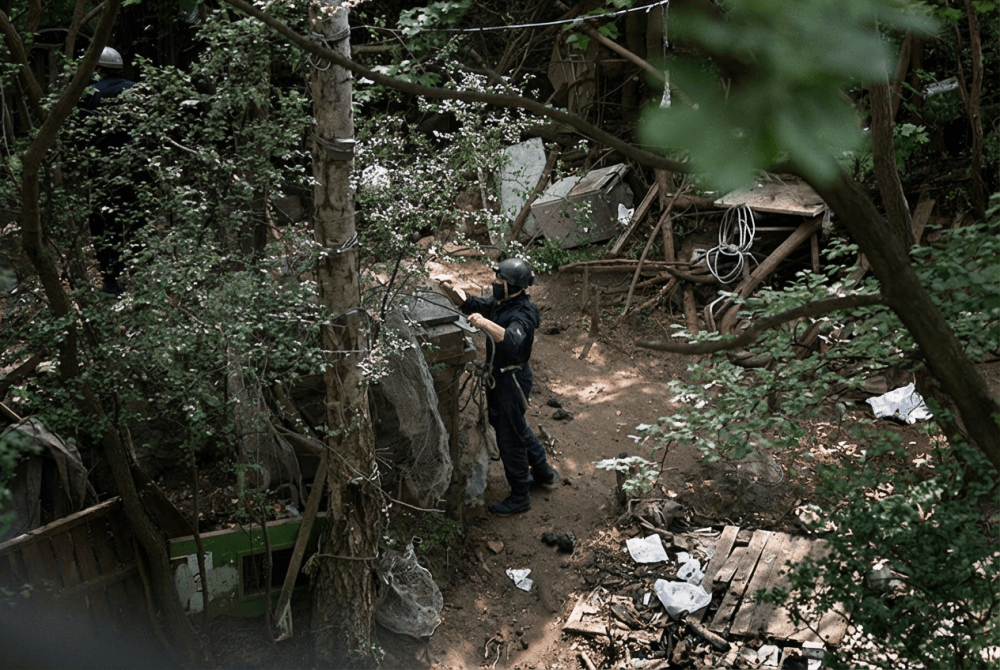
A pot-holer begins work on the Wormhole tunnel. 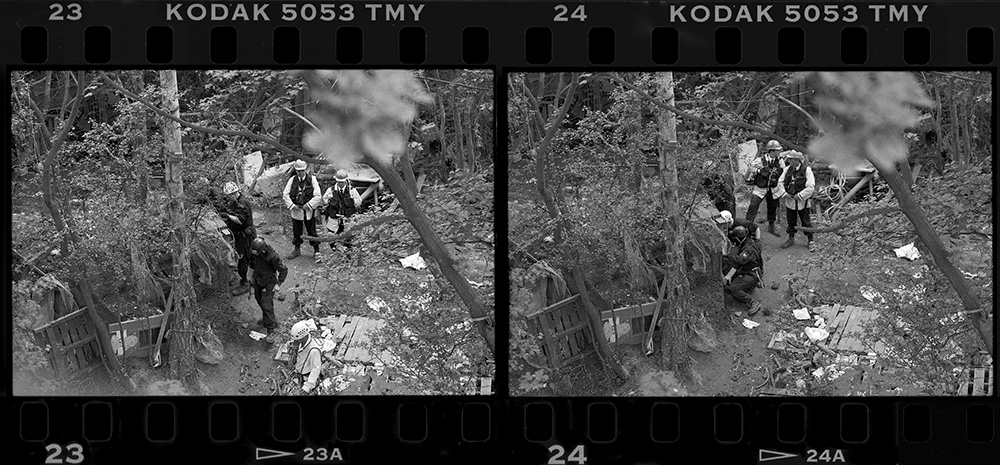
I note that on the ground there are an assortment of round helmets, custodian helmets, peaked caps and hard hats, the latter worn by the bailiffs and security and coloured either white, red or blue, in ascending order of rank. The reflective jackets, say either “Sheriff’s Office” or “Police” on the back. The climbers are dressed in very light grey and the potholers, ominously, in black overalls and balaclavas. The word around the camp is that the potholers are S.A.S. special services. I have no idea if that is true or just one of those stories.
At first, everyone on the ground is filming or photographing the camp, up to the trees, the entrance to the tunnel, us and each other. Then the climbers scale the trees and begin to cut the lowest of the walkways with curved knives and the branches with small chainsaws.
After watching the first bender be brought down and many walk-ways cut I retire to the bender with Mia and James. Mia shares some vegan chocolate with us and we speculate on the progress of the eviction and discuss where each will head for for a last stand. Mia is from will occupy the lock-on beneath bender and James will stay on walk-ways to prevent them being cut. I will remain until I am cornered, at which point I’ll allow them to take me down without resistance. My priority then will be to hang onto my films.
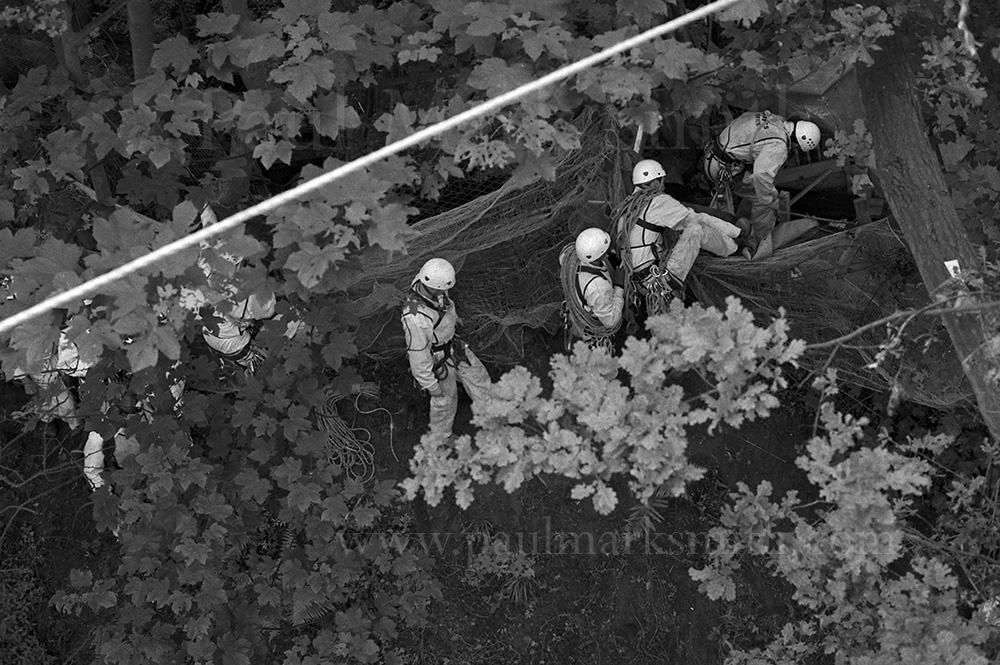
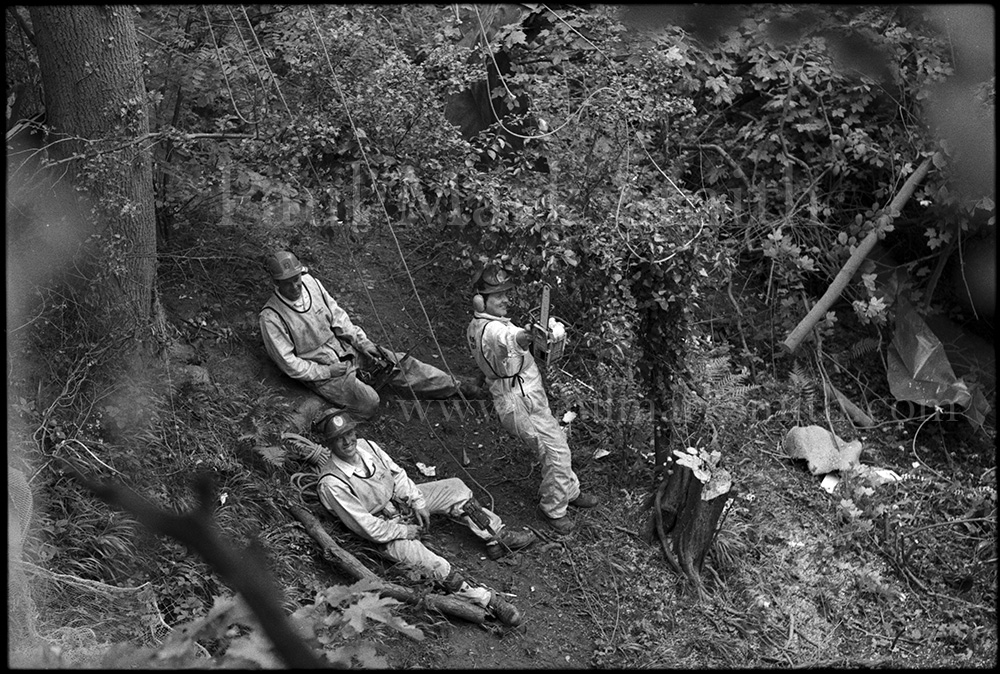
Someone has decided that the protesters are now “The Tribe of Dave”. There are about four Daves in Sir Cliff Camp, so, someone has decided, we may as well all be called Dave.
James, or Australian Dave, confides that he fears he might do something foolhardy: “I’ve been on protests like this before and I usually keep a cool head. But when they start chainsawing the trees I feel I’m going to lose it,” he says.
Mia is now called Moomin Dave, as she’s from Finland. The Moomins are cartoon hippo-like cartoon characters from a Finnish series, the Finn Family Moomintroll. She is sixteen-years-old and has been arrested numerous times for environmental activism. The Daily Mail newspaper labelled her ‘Swampy’s girl’ when Swampy rose to national fame during his six day record-breaking Fairmile tunnel holdout the previous year. It was a record that would be shattered in less than three weeks time by Matt in Flywood camp’s Cakehole Tunnel. He stayed underground for 17 days but received little more than a cursory mention in the news media that had long since moved on. Tunnellers were passé!
·
Below the suspender-bender, a climber looks up at the intricate spiders-web of walk- ways and supporting ropes. “Tricky eh?” Fern calls out, stood on the hovering boards. “What y’ gonna do?”
“Oh, we’ll construct a T and lower you in a net,” replies the climber. “Have you got enough food for two or three days?” he asks. Then, he recognises Dee. “Hey! Weren’t you at Newbury?”
“Yeah, I was at Rickety Bridge,’ replies Dee. ‘You remember me! And wasn’t I nice there too?” The two chat about tree campaigns of past and the tactics the climbers will use over the next three days. So far, the eviction has been ‘fluffy’.
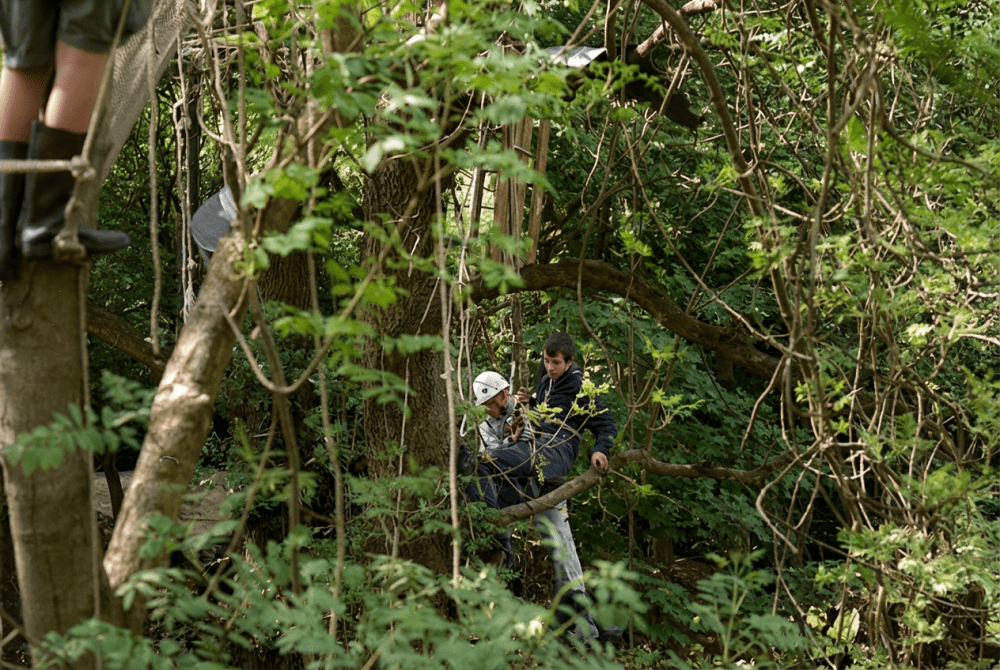
At the end of the first day we take a tally of the day’s fallen. The climbers have plucked one protester from a lock-on in the trees and bailiffs and police have taken away three others from lock-ons at ground level. There is no news of Nadine. Wormhole is still in one piece. It seems that much of the days activity has been dedicated to gathering intelligence on the encampment. Some sixteen of us remain in the trees and four, perhaps five in the tunnels. I relax to the buzz of insects and chatter of birds as the sun goes down. Lazy days!
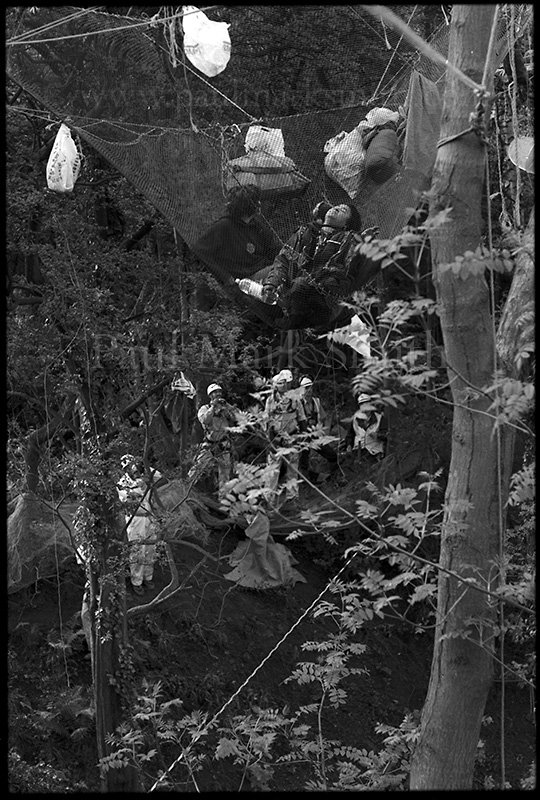
Climbers and bailiffs film and photograph the suspended net. 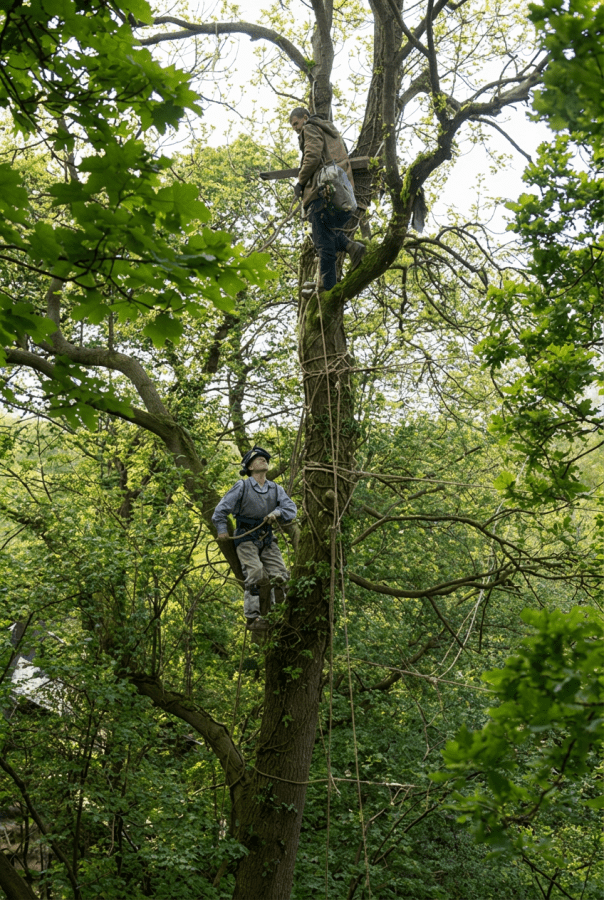
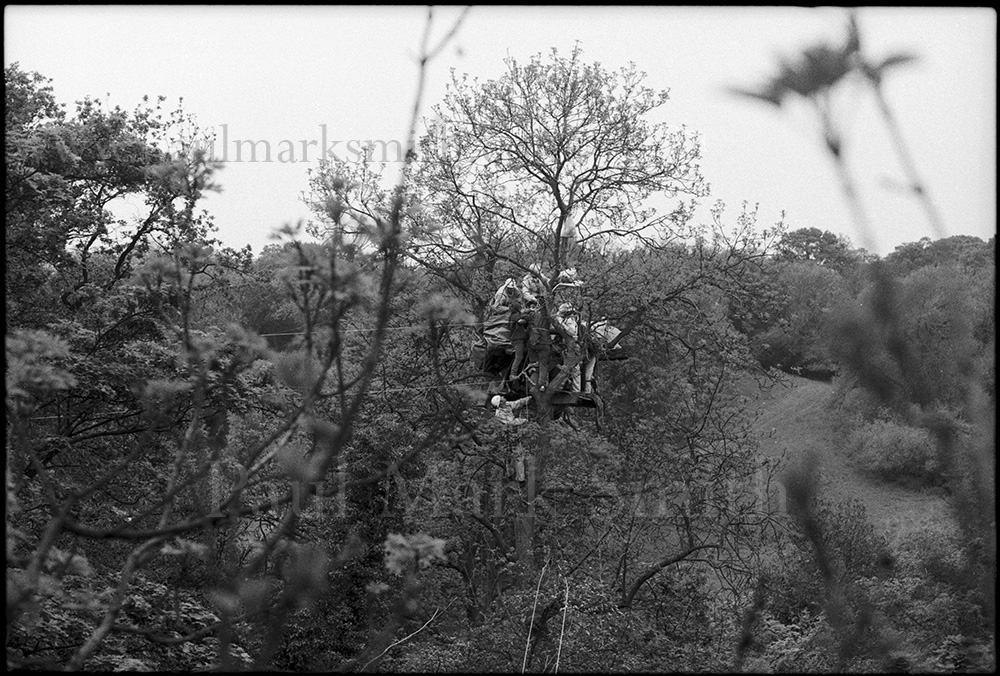
Climbers swarm a bender where protesters lock-on, as others hold the walk ways.
·
Day two begins with frenetic activity. The climbers ascend the trees with speed and take two tree houses within half an hour. They slash the tarpaulins with knives and cast them to the ground. A couple of activists are prised from their lock-ons and lowered to the ground.
James is out on the walkway on the perimeter to stop a climber cutting the lines. The two play cat-and-mouse – James hops from walkway to walkway to prevent a climber cutting them with a curved blade. When James gets the upper hand, the climber move upwards and begins to prune with his chainsaw. Branches fall to the ground, one passing so close to James he has to bat it away with his free hand.
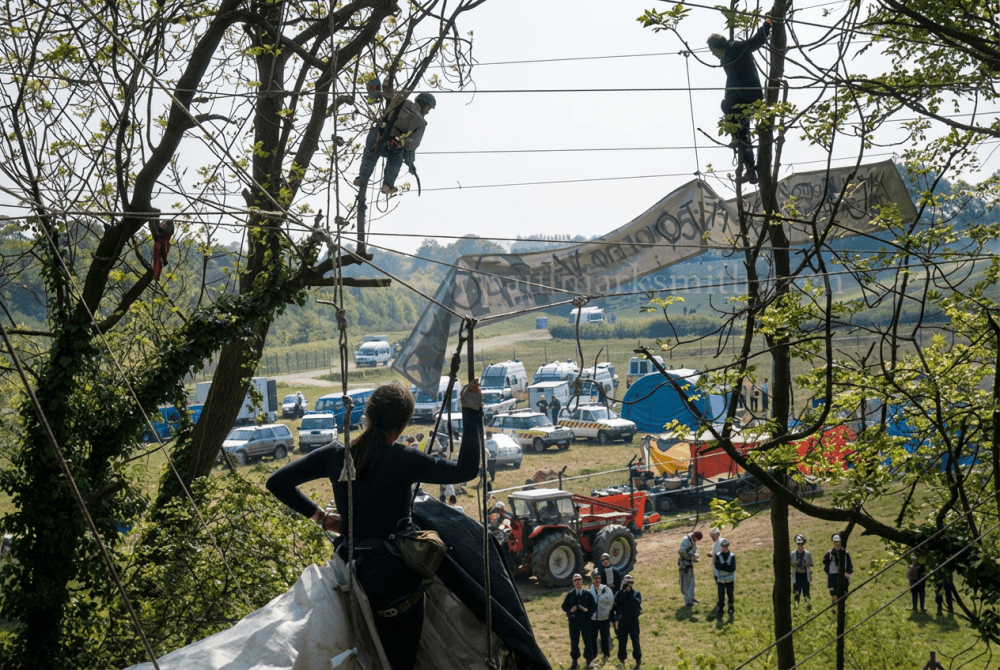
Fern watches-on as a climber makes to cut a walkway rope held by James. 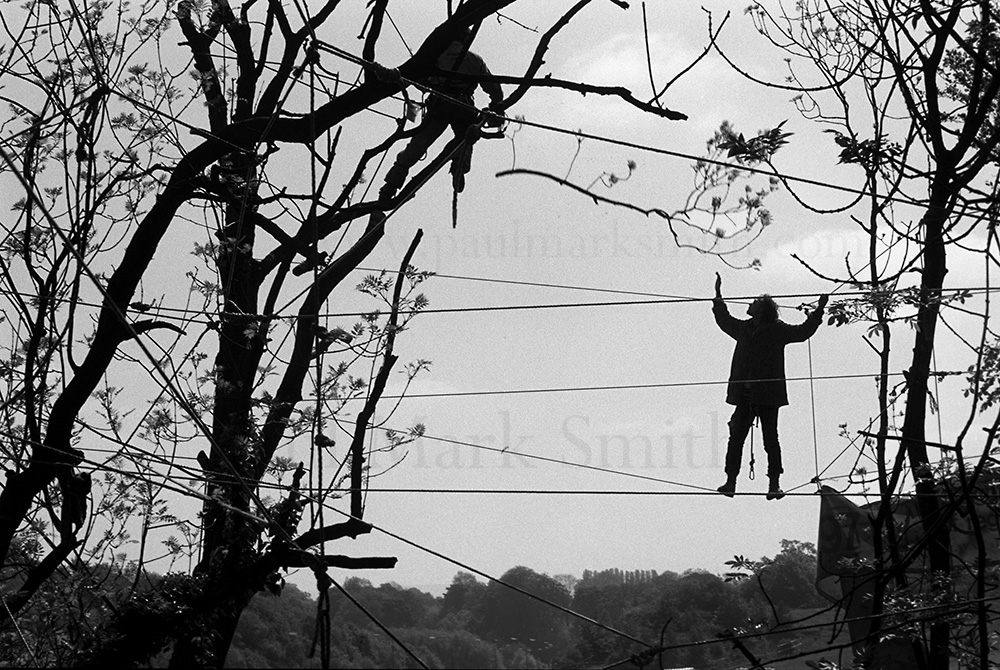
A climber cuts branches as James hinders his work by holding walkways. 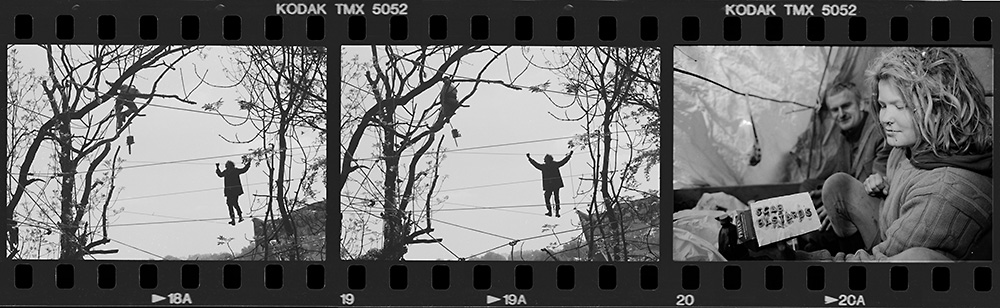
1 & 2 -James on the walkways. 3 – As we share cold spaghetti from a tin, Mia spells out a message for the eviction forces – “Scab Bastards” – in spaghetti letters.
In the bender, Mia, Dave and I share a can of cold spaghetti letters, with which Mia begins to spell out a message. After nicking a B off my fork, she shows me the message to photograph it. “SCAB BASTARDS” it says. Below us, bailiffs have started to chainsaw.
One fells a large section of a cedar tree, which falls onto a couple of the suspender-bender support ropes. The whole structure is pulled down a few feet and pings back violently, catapulting Fern into the air. She almost falls from the platform. Everything stops. It is now quiet, but for the shouts of indignation from Dee and Fern. “Sorry mate!” the offending chainsawer apologises to them. After that, everything seems to calm to a slower pace, just like the first day.
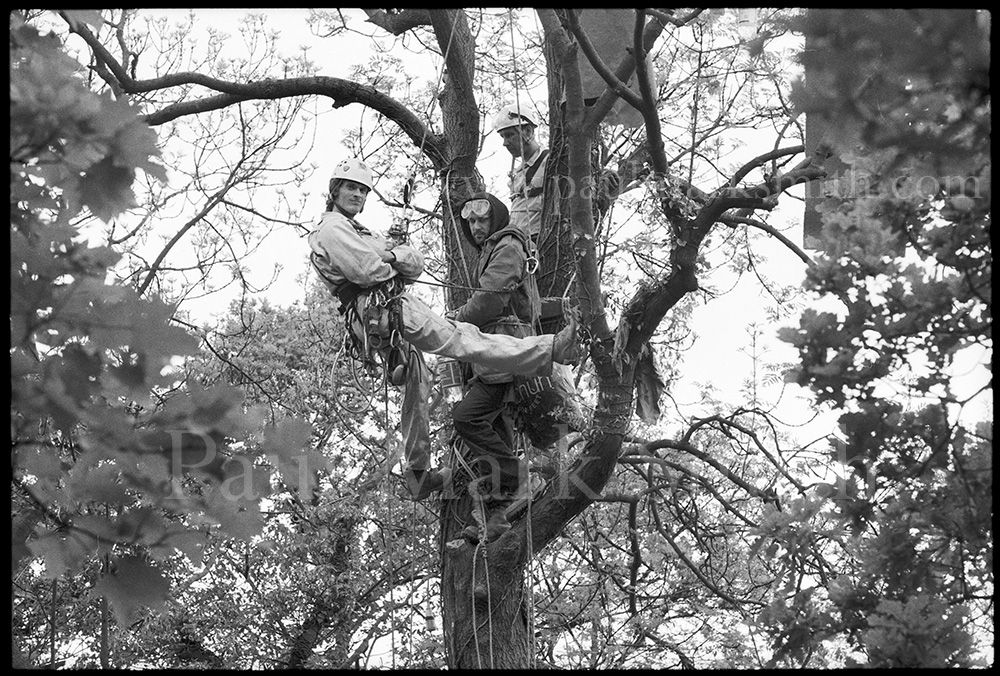
Climbers rest from drilling a lock-on.
For the next few hours, chainsaws cut away the trees below us and, in the distance, two climbers set to work on a concrete barrel where Kev – lock-on Dave – is locked-on. He wears large safety goggles and ear defenders the climbers have put on him. When the climbers turn their backs, he pulls his arm from the barrel to wave to us and flash a mischievous smile.
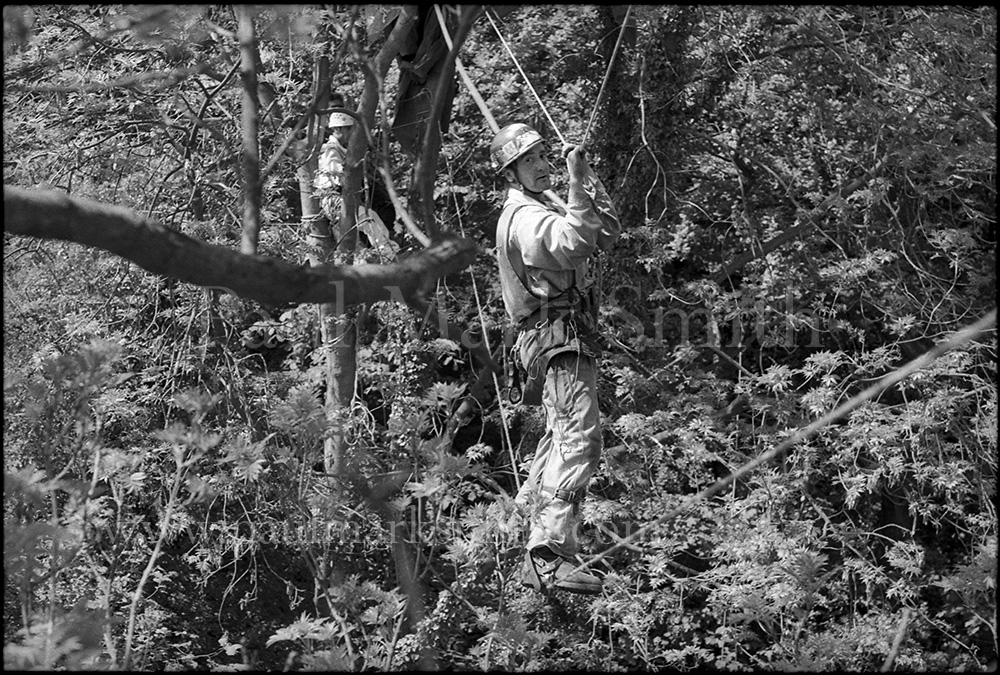
Climber “Sir” Ian Whitaker crosses the walkway to the bender.
In the late afternoon, climbers reach our bender. As they arrive, Mia climbs off the platform and scales down the tree to a lock-on a few metres below. James and Dave (a genuine) stand on a couple of walkways leading from to and from so they will not be cut and I duck into the bender to stash thirteen rolls of exposed film in my underpants. In my camera bag, I leave a few unexposed rolls as decoys. As I am about to pop my head out, a curved blade cuts through the tarpaulin and I come face to face with the first climber to arrive in our tree. “Hello! What’s your name?” I ask.
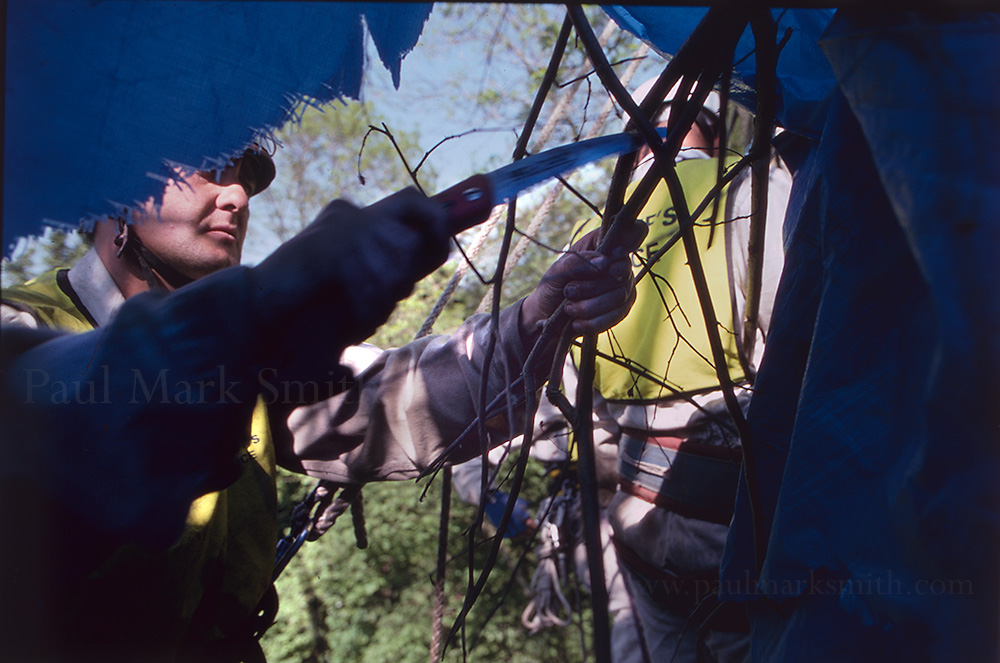
Sir Whitaker puts our bender to the sword. 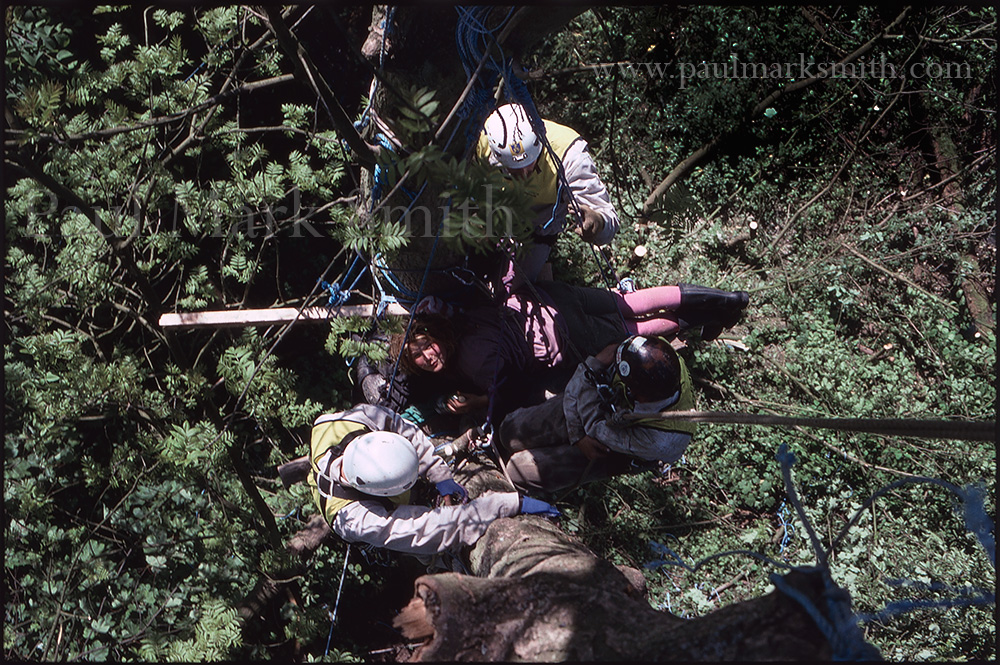
Mia locks-on below the bender platform and climbers and bailiffs prepare the long task of percussion drilling.
He is called Ian Whittaker and, like many of the protesters, is a veteran of environmental protests. I tell him that I’ll go without resistance and he calls for some ropes and a harness to lower me to the ground. As we wait for the gear to arrive, we chat for a about twenty minutes. He tells me that they had been instructed to speed up the eviction that day because of the yesterday’s modest bounty. “For us, there’s no hurry. We’re on a pound a minute,” he says.
He tells me a little about how they work and about other protests he has evicted. He was at the “third battle of Newbury”, where he was knighted a Sir Arthur Pendragon. “He told me only a knight can take a king and knighted me then and there, saying ‘Arise Sir Ian‘ as he touched his sword on my shoulders.”
As they help me into the climbing harness on what is now just a wooden platform – the bendar has been cast to the ground – Dee cries out ” No, don’t take him! He’s our leader!” Other voices join in. “Leave him! He’s our leader. Paul’s our leader,” they shout and laugh as I am lowered down to ground, where I shake hands with Sir Ian before police officers read me my rights and arrest me. As I am led out of the encampment by two policemen who hold me by my arms, my friends in the trees wave goodbye and call out “Paul’s our leader.”
Only then does it occur to me that I should have asked Sir Ian to knight me too. I’m pretty sure he would have obliged.
Life on Earth
I am searched, photographed, fingerprinted and videoed several times throughout my arrest: on my way down from the trees; on my way out of the camp; on my way to the police van; and when I arrive at the station. The processing officers at Wilmslow police station order me to remove my belt and remove the boots I have been wearing for three days without changing socks. When I do so, they recoil and decide not to do a full frisk search. I take the laces out of my shoes and stuff them in an envelope, sign the list detailing my possessions and am directing to a cell. The thick, iron door is slammed shut. After four hours, they let me out and formerly charge me with resisting arrest. I am bailed to appear in the magistrate’s court within a month.
On the grass verge outside the police station, I come across Kev from Sir Cliff sat on the grass. Kev had never taken a shine to me, as I was a journalist and he “didn’t like journalists”. However, he is quite friendly and we chat and, as we compare charge sheets, I unpack the thirteen rolls from my underpants and stash quickly in my bag. Before I leave to get a bus back to London, Kev tells me “You’re alright. You stayed and got nicked, just like us.” We bid farewell with a smile and a man hug.
·
My case was one of the first to come to trail, a month later in Wilmslow Magistrates Court. I was defended by a barrister contracted by the National Union of Journalists. In the case against me, police depositions argued that I was one of the leaders of the protests. Quite amused, I explained the dynamics of camp and the jokey banter. My barrister and I also argued that I had not heard the verbal warning at the beginning of the eviction of Sir Cliff Richard OBE Vegan Revolution camp because of the noise and shouts of bollocks etc. from the protesters. “All I heard was bollocks your honour.”
The magistrates seemed bent on convicting me but the climber, Ian Whittaker, came to the rescue. In his deposition, he clearly stated that i had not resisted but cooperated. They had charged me with the wrong thing – obstruction and resisting arrest. Sir Ian turned out to be me knight in a shining, if somewhat mucky, overall. Much to the chagrin of the magistrates, the case was dismissed. I was found not guilty.
End

